 EN
EN

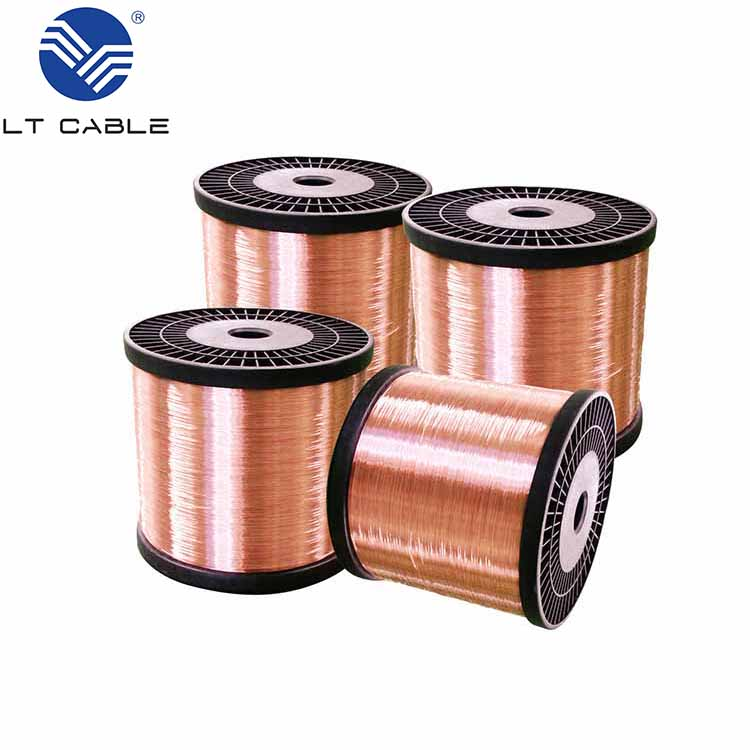
Copper Ratio: The Dominant Cost and Performance Factor in TCCA Wire
How copper cladding percentage (10%, 15%, 20%) scales raw material cost and DC resistance
The proportion of copper cladding on the aluminum core is the single most influential variable in TCCA wire economics and electrical performance. A 10% copper volume ratio typically reduces raw material cost by 40–45% versus solid copper—leveraging aluminum’s abundance and low density—while cutting weight by 25–30%. This makes it especially valuable in aerospace and automotive harnesses where mass savings translate directly to efficiency gains. However, lower copper content raises DC resistance: a 12 AWG TCCA wire with 10% cladding exhibits ~22% higher resistance than its solid-copper counterpart, increasing voltage drop and limiting current-carrying capacity.
Raising the copper ratio to 15% improves conductivity to approximately 85% IACS, narrowing the resistance gap and moderating cost savings to 30–35%, with weight reduction tapering to 15–20%. At 20% copper, conductivity often reaches 90% IACS or more—approaching pure copper performance—but cost advantages shrink to just 20–25%. As such, the copper ratio represents a calibrated trade-off: lower percentages maximize upfront material savings; higher ones prioritize electrical fidelity and long-term system efficiency.
Metallurgical limits: bonding integrity degradation and conductivity loss below 15% copper
Below 15% copper, metallurgical constraints begin to outweigh cost benefits. A continuous, defect-free copper–aluminum interface is essential for both mechanical reliability and stable conductivity. Thinner cladding increases susceptibility to interfacial voids and brittle intermetallic compounds during drawing or thermal cycling—degrading bulk conductivity, sometimes to under 60% IACS despite nominal composition. More critically, thin copper layers are prone to delamination during crimping, bending, or vibration. In automated termination, mechanical stress can peel the copper skin from the aluminum core, exposing aluminum to oxidation and galvanic corrosion. Field evidence shows such wires may pass initial testing but suffer accelerated resistance rise and premature failure.
For this reason, high-reliability applications—including those governed by SAE AS50881 or UL 758—routinely specify a minimum 15% copper cladding. Below that threshold, elevated scrap rates, rework, and field failures often negate the raw material advantage—making 15% the practical floor for robust TCCA design.
Tin Plating Thickness and Process: Controlling Corrosion Resistance and Manufacturing Cost in TCCA
Hot-dip vs. electroplating: trade-offs in uniformity, adhesion, scrap rate, and TCCA yield
The choice between hot-dip and electroplating significantly influences TCCA wire’s cost structure and functional reliability. Hot-dip tinning forms a metallurgical bond with the copper surface, delivering strong adhesion—particularly beneficial for subsequent drawing or crimping. But immersion in molten tin inherently yields thickness variation of ±30%, increasing tin consumption and scrap when coatings fall outside specification.
Electroplating, by contrast, enables precise control over tin thickness—reducing raw material waste and supporting tighter tolerances. Its limitation lies in adhesion: without proper surface preparation and post-plating heat treatment, the tin layer may delaminate during forming or thermal cycling. Industry data indicates that unoptimized electroplating contributes to up to 12% of plating-related yield loss in high-volume TCCA production. Leading manufacturers mitigate this risk with controlled activation chemistry and diffusion annealing, though these steps add process complexity and cost. Ultimately, hot-dip prioritizes bond integrity at higher material expense; electroplating demands tighter process discipline to preserve yield.
Optimal tin thickness range (0.8–2.2 µm) for TCCA: balancing corrosion protection with process efficiency
A tin coating thickness of 0.8–2.2 µm represents the optimal balance of corrosion protection, manufacturability, and cost for TCCA wire. Below 0.8 µm, microporosity and incomplete coverage expose underlying copper to oxidation and accelerate galvanic corrosion—especially in humid or elevated-temperature environments. Salt-spray testing reveals that coatings under 0.7 µm correlate with a 40% increase in contact resistance after 1,000 hours.
Above 2.2 µm, additional tin provides diminishing returns on corrosion resistance while raising risks: tin whisker formation increases, and excessive stiffness hinders wire formability in tight routing applications. Process efficiency also suffers—hot-dip lines slow down to achieve thicker coatings, and electroplating requires careful current-density management to avoid nodular growth. The 0.8–2.2 µm window aligns with the capabilities of modern high-speed plating lines, sustaining throughput while meeting IPC-4552B and MIL-DTL-16500K requirements for tin-coated conductors.
Yield Optimization: The Hidden Multiplier Affecting TCCA Wire Unit Cost
Drawing-induced delamination and plating adhesion failure as primary yield killers in TCCA production
Drawing-induced delamination and plating adhesion failure are the two dominant yield detractors in TCCA manufacturing—each directly inflating unit cost through scrap, rework, and throughput loss. During wire drawing, tensile stress concentrates at the copper–aluminum interface. If cladding is too thin (<15% by volume) or metallurgical bonding is inconsistent, micro-voids initiate and propagate, causing visible or subsurface delamination. A 2023 study across six Tier-1 wire processors found delamination alone contributed to 18–22% scrap—effectively eliminating the material-cost advantage of TCCA versus solid copper.
Plating adhesion failure compounds the issue. Tin must bond cohesively to the copper surface, which demands rigorous pre-treatment: ultrasonic cleaning, acid activation, and moisture-free drying. Residues from inadequate cleaning—or mechanical damage during high-speed drawing—can create weak interfacial zones. Under thermal cycling or flexing, these zones blister or peel, exposing copper to oxidation and undermining long-term corrosion resistance. In a 2024 industry survey of high-frequency cabling suppliers, plating adhesion failure accounted for 14% of all TCCA returns.
Mitigating these issues requires integrated controls: inline ultrasonic inspection to verify cladding integrity before plating, real-time bath monitoring for tin concentration and pH, and closed-loop tension management during drawing. When deployed consistently, such measures stabilize yields above 92%—transforming TCCA from a marginal alternative into a scalable, margin-resilient solution.
FAQ Section
What is the primary factor influencing cost and performance in TCCA wire?
The copper cladding percentage on the aluminum core is the dominant factor, as it scales raw material costs, weight reduction, and electrical properties.
Why is the minimum copper cladding percentage set to 15% for high-reliability applications?
Below 15% copper, bonding integrity degrades, increasing susceptibility to delamination, conductivity loss, and field failures, which outweigh cost benefits.
What are the advantages and disadvantages of hot-dip vs. electroplating tin processes?
Hot-dip tinning ensures strong adhesion but has thickness variability. Electroplating offers precise control over tin thickness but requires meticulous process discipline to prevent delamination.
What is the optimal tin thickness range for TCCA wire?
The recommended thickness is 0.8–2.2 µm, balancing corrosion protection, manufacturability, and performance.
How can yield losses like delamination and plating adhesion failure be mitigated?
These losses can be reduced through ultrasonic inspection, real-time process monitoring, and integrated tension management during production.
Table of Contents
- Copper Ratio: The Dominant Cost and Performance Factor in TCCA Wire
- Tin Plating Thickness and Process: Controlling Corrosion Resistance and Manufacturing Cost in TCCA
- Yield Optimization: The Hidden Multiplier Affecting TCCA Wire Unit Cost
-
FAQ Section
- What is the primary factor influencing cost and performance in TCCA wire?
- Why is the minimum copper cladding percentage set to 15% for high-reliability applications?
- What are the advantages and disadvantages of hot-dip vs. electroplating tin processes?
- What is the optimal tin thickness range for TCCA wire?
- How can yield losses like delamination and plating adhesion failure be mitigated?


