 EN


How to understand the drawing process in copper clad aluminum wire production
Drawing copper clad aluminum wire means pulling a bonded composite through a succession of smaller dies. The diameter falls as the wire length increases, while the copper surface and aluminum core deform together. For a cable manufacturer, the question is not just whether the finished wire reaches its target size. It is whether the wire retains a sound bond, an appropriate temper and a surface that will work in the next operation.
This guide follows the material from incoming composite stock to a finished spool. The sequence is a general explanation, not a claim about a particular production line. Die schedules, lubrication and heat treatment require validation for the actual material and equipment.
What enters the drawing line?
Copper clad aluminum wire has an aluminum core surrounded by a copper layer. Depending on the manufacturing route, the composite stock is formed and bonded before the drawing passes described here. Drawing is not the same operation as applying a thin coating to an already finished wire: the two metals are reduced together as a composite.
Before drawing, operators identify the incoming diameter, copper proportion, surface condition and material lot. A surface mark or a weakness in the bond can be carried into later passes. Confirming the starting condition also makes it easier to interpret a problem found on a finished reel.
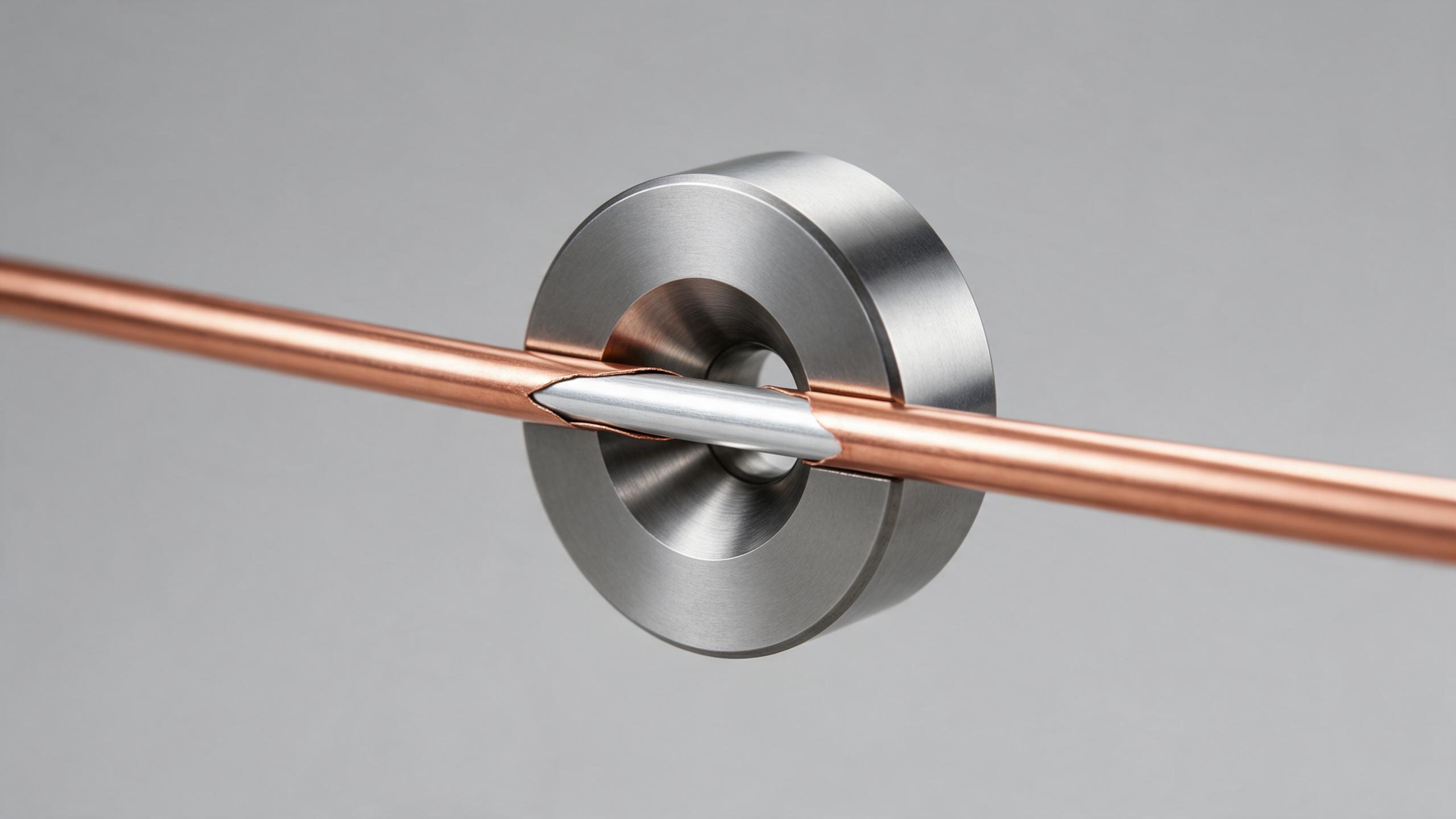
How the wire drawing process changes the composite
During the wire drawing process, a drawing machine pulls copper clad aluminum wire through a die with an opening smaller than the incoming wire. The die constrains the metal as the wire passes through; the cross-sectional area decreases and the length increases. A line normally uses several passes rather than attempting the entire size change in a single step.
Each pass has a defined incoming diameter and outgoing diameter. The sequence of dies is the draw schedule. It must account for the composite construction, the condition of the stock, the machine and the required final properties. Copper and aluminum do not respond identically to deformation, so the schedule needs to keep the layer and core working together without excessive damage.
Read reduction by area, not just diameter
For round wire, area reduction equals (initial area minus final area) divided by initial area, multiplied by 100. Because area depends on diameter squared, a modest-looking diameter change can represent a larger change in cross section. For example, drawing from 2.0 mm to 1.8 mm gives an area reduction of 19% for that pass. This is arithmetic for an example, not a recommended production setting.
In a published laboratory study of multistage drawn CCA, researchers described 20% cross-sectional reduction between stages and 89% total reduction before studying annealing. Those values describe that experiment; they are not a universal schedule for every diameter or composite design.
Which controls matter during drawing?
Die condition and alignment
The die sets the exit size, but the die geometry and surface also influence the contact with the wire. Wear, deposits or damage can produce scratches and size variation. Alignment matters because an uneven pull can increase contact on one side. A drawing team can check the wire surface and diameter at planned intervals and review die condition when a repeated defect appears.
Lubrication, cooling and speed
Lubricant separates contacting surfaces and helps manage friction. Its suitability depends on the wire, die material and line arrangement; cleanliness and delivery to the contact zone matter as well. Speed, friction and deformation can raise temperature. Temperature management should be considered alongside lubricant condition rather than treated as a separate dial that fixes every problem.
For copper clad aluminum wire, changes to speed, a worn die or contaminated lubricant may show up as surface marks, unstable dimensions or breaks. These symptoms are signals to investigate, not proof of a single cause. Record the pass, reel and process conditions before changing several settings at once.
Tension and take-up
The pull between passes and the winding tension at the take-up reel must suit the wire size and machine. Excessive or unstable tension can contribute to breaks or winding problems. Poor winding can damage the surface or create difficulties when the next process pays off the reel. A reel that looks tidy is useful, but it does not replace dimensional and material checks.
Where does annealing fit?
Cold drawing changes the mechanical state of the material. If the finished application needs a different balance of strength and ductility, a producer may use annealing at an appropriate stage. The cycle depends on the composite and the desired condition; it should be agreed and validated rather than copied from a generic chart.
Annealing is not automatically required for every order. Excessive heat exposure can change the junction between metals and alter properties. Ask whether the supplied condition is hard drawn or annealed, which properties are specified, and how they are checked on the finished lot.
What should be checked on the finished wire?
A single measurement cannot describe copper clad aluminum wire. An inspection plan should connect measurable requirements to the intended downstream use. Depending on the agreed specification, useful checks can include:
- Dimensions: diameter and tolerance at agreed locations and frequency.
- Surface: scratches, seams, exposed core or other visible damage.
- Construction and bond: copper proportion and integrity assessed by an agreed method.
- Mechanical condition: tensile or elongation checks suited to the required temper.
- Electrical performance: resistance or conductivity measured under the agreed conditions.
- Reel and traceability: identification, winding quality and the connection between test results and the supplied lot.
Acceptance criteria, sampling and test methods should be agreed for the purchase. A visible surface check cannot on its own establish the bond or electrical characteristics throughout a reel. Equally, a test result from one sample does not automatically describe every production condition.
How to discuss the process with a supplier
Start with the final use and the next manufacturing step: for example, whether the wire will be stranded, insulated or used as a coaxial conductor. Then share the diameter and tolerance, copper proportion, required temper, electrical and mechanical criteria, and reel requirements. Identify the applicable standard and revision if one is required for the project, rather than assuming a standard applies to every application.
Ask what evidence accompanies a sample or production lot and how a change in material, size or process will be communicated. A trial on the actual downstream equipment can reveal handling issues that a specification sheet alone may not show. The material comparison guide offers a related starting point when the conductor choice is still under review.
Litong Cable Technology Co.,Ltd lists CCA and other conductor materials in its portfolio. For an inquiry about copper clad aluminum wire, provide the intended application and inspection requirements so the technical discussion can begin with the same assumptions. Final suitability remains subject to the agreed specification and validation on the buyer's process.


