 EN


Choosing an inner conductor for an RF coaxial cable is not simply a choice between copper and aluminum. A well-specified copper clad aluminum wire combines a copper outer layer with an aluminum core, so the decision should begin with the cable’s operating frequency, attenuation target, size, weight, mechanical handling, and manufacturing window. From a conductor-material advisor’s perspective, the useful question is not “Is CCA the right material by default?” but “Does this construction fit the electrical and process requirements of this cable?”
For many RF applications, copper clad aluminum wire can be a practical center-conductor option when the design relies on high-frequency surface-current behavior and values lower conductor mass. It still needs to be validated against the complete cable construction. Dielectric geometry, conductor diameter, cladding quality, surface condition, and the finished cable test plan all affect the final result.
What changes at RF frequencies?
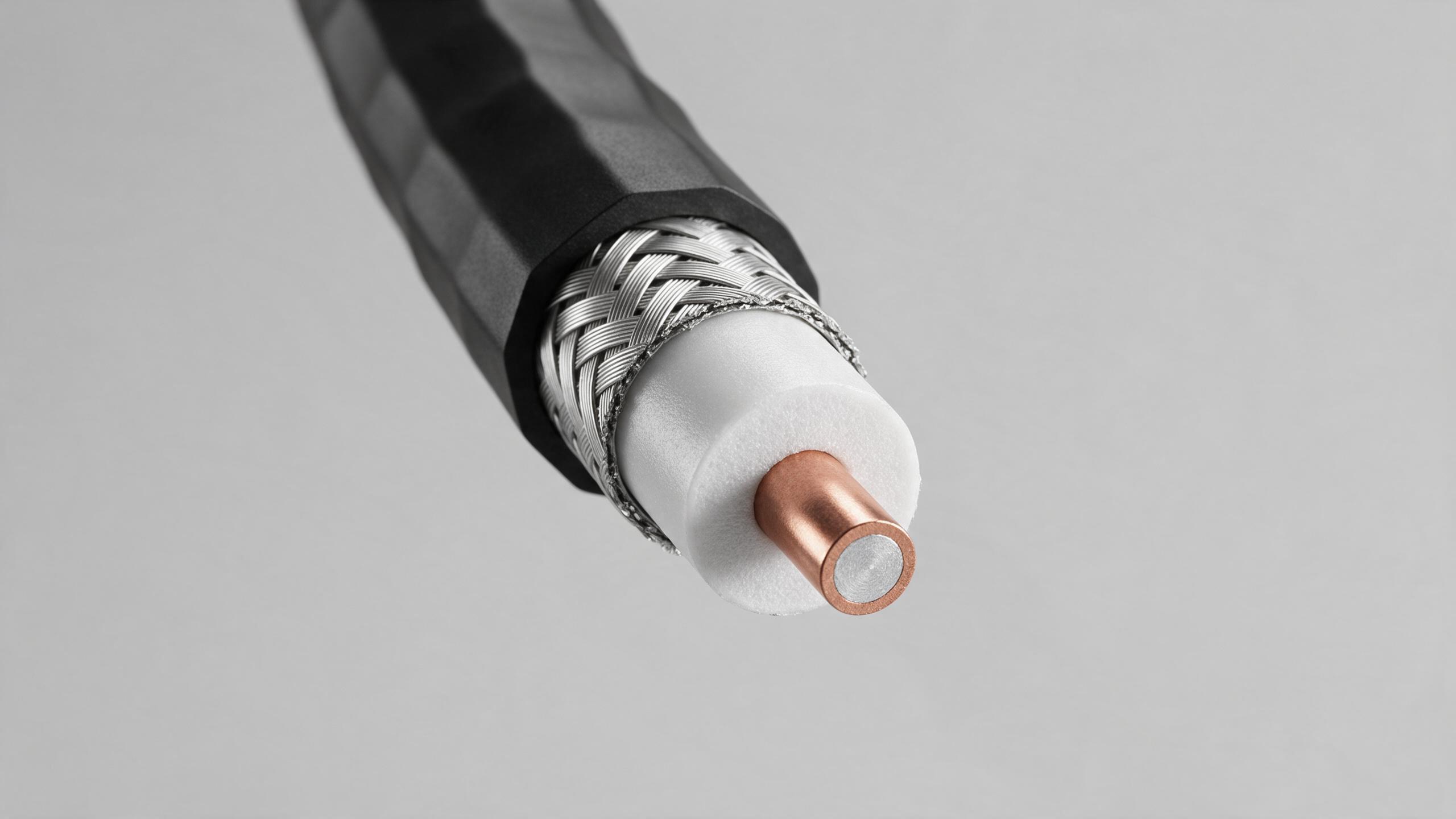
In a coaxial line, the center conductor and the shield carry the signal, while the dielectric maintains the spacing that determines impedance. At higher frequencies, current tends to concentrate closer to the conductor surface; this is commonly called skin effect. That is why the copper layer of a copper clad aluminum wire is relevant in an RF coaxial cable: the outer material is where much of the high-frequency current is concentrated.
That principle should not be simplified into a blanket performance claim. Skin depth changes with frequency, material properties, and temperature. A copper layer that is appropriate for one frequency range or cable size may need a different evaluation for another. Surface smoothness and continuity matter as well, because RF loss is not determined by bulk material names alone.
Why the copper-clad construction can fit an RF coaxial cable
1. It combines a conductive surface with a lighter core
The copper outer layer provides the surface material relevant to RF current flow, while the aluminum core reduces mass compared with an all-copper conductor of the same overall size. This can be useful when cable handling, reel weight, or installation load is part of the design brief. The benefit is a construction trade-off, not a substitute for checking attenuation at the specified operating band.
2. It gives designers another way to balance size and handling
Conductor selection often sits between electrical targets and physical constraints. An RF coaxial cable may need a defined center-conductor diameter to work with a chosen dielectric and shielding geometry. Copper clad aluminum wire gives the designer a material option that can be assessed within that geometry instead of treating conductor weight and RF behavior as unrelated decisions.
3. It supports a specification-led sourcing conversation
CCA is not a single, self-explanatory material grade. A useful request should identify the conductor size, cladding requirement, intended frequency range, temper or mechanical requirements, and the tests that will be used for acceptance. ASTM B566 is one example of a standard specification associated with copper-clad aluminum wire, but a wire standard alone does not demonstrate that a finished RF coaxial cable will meet its electrical targets. Cable-level testing remains essential.
Copper clad aluminum wire versus solid copper: use the right comparison
| Decision factor | Copper clad aluminum wire | Solid copper center conductor |
|---|---|---|
| RF surface behavior | The copper cladding is relevant where current is concentrated near the surface; confirm cladding and finished-cable loss at the intended band. | Uses copper throughout the cross-section; still requires cable-level loss and impedance verification. |
| Mass | Typically offers a lower-mass construction at a comparable overall conductor size. | Has a higher material mass for the same overall size. |
| Low-frequency or DC resistance | Must be checked explicitly because the aluminum core affects bulk resistance. | Often selected when low DC resistance is a primary requirement. |
| Manufacturing compatibility | Needs confirmation through drawing, straightening, insulation, and cabling trials for the selected construction. | Also needs process validation, though the material behavior is familiar in many cable lines. |
| Acceptance basis | Specify wire construction plus finished RF coaxial cable electrical and mechanical tests. | Specify the same cable-level tests rather than assuming performance from material alone. |
The table is deliberately conditional. If low-frequency resistance, a particular termination method, or a demanding mechanical condition is the dominant requirement, the comparison can change. Material differences need to be explained in the actual process and end use; a ranking without that context has limited value.
Checks to make before approving CCA for a coaxial center conductor
A specification review is usually more useful than a generic yes-or-no answer. Before approving copper clad aluminum wire, align the following points between engineering, production, quality, and the wire supplier:
- Define the signal use. State the operating frequency range, attenuation objective, cable length, and any impedance requirement for the RF coaxial cable.
- Confirm the conductor construction. Record nominal diameter, copper-cladding requirement, roundness, surface condition, and permitted dimensional tolerance.
- Separate RF and DC requirements. Do not use a favorable high-frequency argument to bypass a low-frequency resistance check where that check matters.
- Review downstream processing. Confirm how the wire behaves through straightening, insulation extrusion, foaming if applicable, and cabling. A theoretically suitable material still needs to fit the existing process window.
- Agree on verification. Use samples and documented measurements for conductor dimensions, electrical behavior, bonding or cladding-related requirements, and finished-cable attenuation and impedance.
A common rework point is not the material itself but an incomplete front-end specification. For example, saying “CCA center conductor” without defining diameter, test method, or the intended RF range leaves too much open to interpretation. Sample evaluation is valuable because it closes the information gap between a material description and a real cable line.
Where the choice needs extra caution
Copper clad aluminum wire may not be the preferred choice when the design is governed chiefly by very low DC resistance, unusually demanding connector or termination behavior, severe bending requirements, or customer specifications that explicitly require another conductor construction. This is not a defect in CCA; it is a reminder that no conductor material is automatically right for every coaxial application.
It is also important not to infer quality from appearance alone. The copper surface, the bond boundary between materials, dimensional consistency, and the match to the cable process deserve objective checks. If a claim about a particular grade, test result, or certification has not been confirmed, it should remain a request for documentation rather than a published fact.
A practical selection conclusion
Choose copper clad aluminum wire for the internal conductor of an RF coaxial cable when its copper surface, reduced-mass construction, and process compatibility align with the required frequency range and finished-cable test plan. The strongest case is not “CCA versus copper” in isolation. It is a documented comparison of RF loss, DC requirements, geometry, mechanical handling, and production validation for the specific cable.
Litong Cable Technology Co.,Ltd serves telecom and coaxial-cable applications and can use a specification-led conversation to help frame those inputs. Start with the end use, define the conductor and cable checks, then confirm the result with a representative sample. That approach gives the material decision a clear engineering basis.


