 EN


Why use copper clad aluminum wire for braiding layer of shielded data cables
A braid designer has to balance electrical shielding, cable weight, manufacturability and cost. Copper clad aluminum wire offers one way to make that trade-off: each strand has an aluminum core surrounded by copper. For a shielded data cable, the appeal is a lighter metallic braid with a copper outer surface. Whether it works depends on the finished cable, not the material name alone.
The distinction matters. The braid is a shield around the insulated signal conductors; it is not automatically the signal conductor itself. A cable specification may permit one material for the shield and require another for the data pairs. Review the complete construction and the applicable requirements before changing either component.
What the braid does around a data cable
A braided shield is formed by interlacing fine wires around the cable core. It provides a conductive path around the protected elements and helps control coupling between the cable and its electromagnetic environment. Braid is flexible compared with a continuous metal tube, but its interwoven geometry leaves openings. A foil layer can also be included in some designs; its contribution depends on the complete construction and termination.
In shielded data cable braiding, the strand material, wire diameter, bobbin arrangement, braid angle and coverage all influence the resulting structure. A shield with good visual coverage is not necessarily the one with the lowest transfer impedance. Frequency, connector contact, continuity and installation all matter, so performance must be measured on representative cable assemblies.
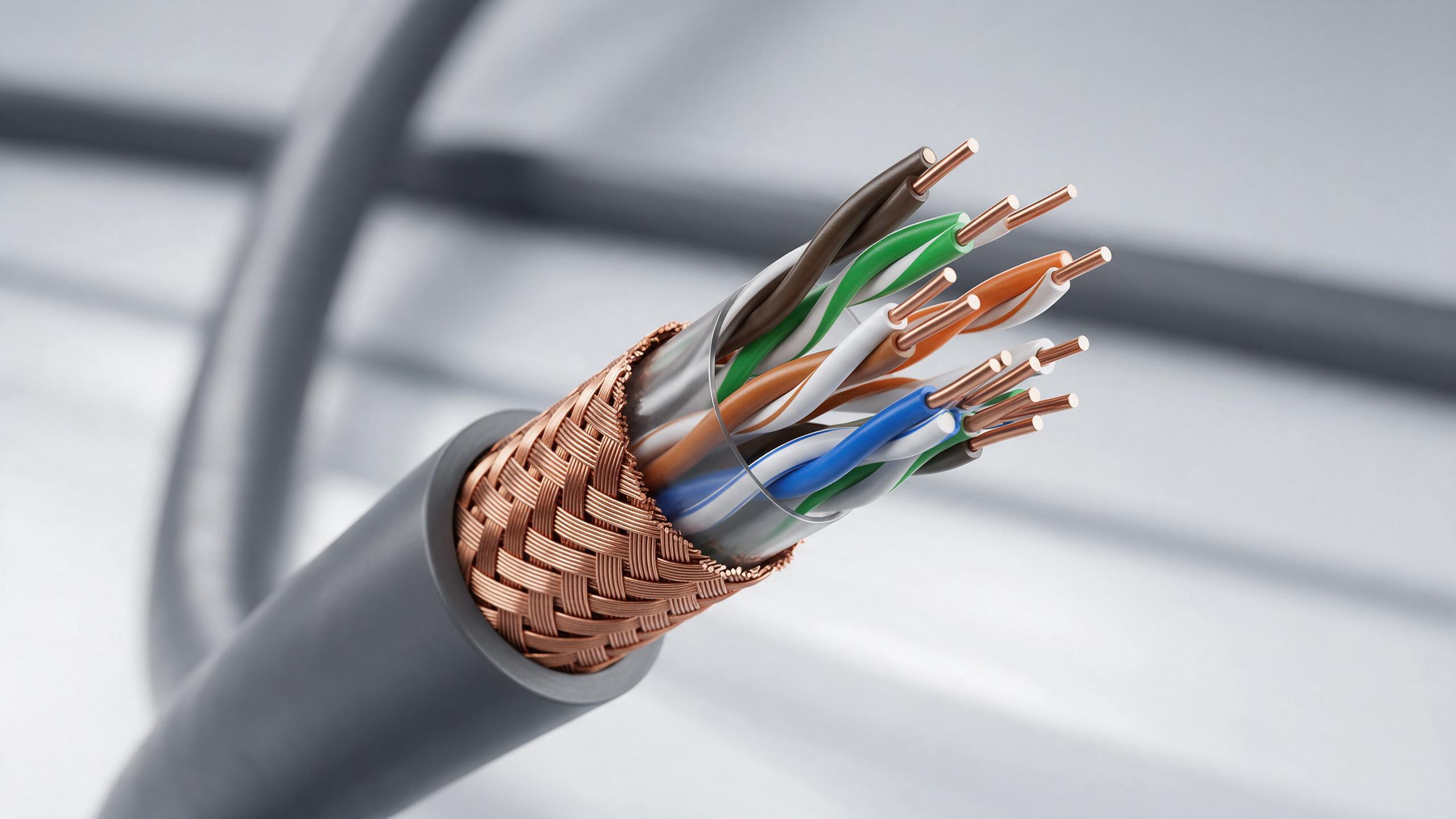
Why consider copper clad aluminum wire?
Less weight than an equal-volume copper strand
Aluminum is less dense than copper. For a strand of the same outside diameter, replacing part of the copper cross-section with an aluminum core reduces its mass, although the reduction depends on the actual copper fraction. Across a full braid, weight also depends on the number of ends, geometry and coverage. Compare finished constructions rather than applying a generic saving to every cable.
Lower braid mass can matter when a cable is long or when handling weight is a design constraint. It does not establish a particular bending life or mechanical rating. Those properties need to be checked with the finished cable and its intended installation conditions.
A copper surface with a different electrical cross-section
The copper surface of copper clad aluminum wire is relevant to contact and to high-frequency current distribution. At higher frequencies, current tends to concentrate nearer the conductor surface; how much the copper layer matters depends on frequency, wire dimensions and cladding thickness. At lower frequencies, current also flows in the core, so a CCA strand must not be assumed to have the same direct-current resistance as an equal-diameter solid copper strand.
Shielding is a system property. Compare the proposed braid with a copper alternative by testing transfer impedance or shielding effectiveness across the specified frequency range, using the same cable geometry and termination method. Avoid inferring a pass from strand conductivity alone.
Material economics with a qualification cost
Because part of the strand volume is aluminum, copper clad aluminum wire can be considered when the amount of copper in a braid is an important cost input. Metal prices, copper fraction, strand size and order terms affect the actual comparison. Savings are not automatic, and the wire price alone omits braid yield, processing changes, testing and potential connector work.
Before calculating the economics, compare the materials on the same basis: finished cable length, required coverage, production speed and acceptance criteria. A less expensive reel that runs poorly or requires a different termination can change the total calculation.
How wire and braid geometry interact
Start with the shielding target and physical envelope. Then specify the strand diameter and tolerance, copper cladding requirements, tensile properties and elongation appropriate to the braider. For a given design, the number of bobbins, ends per bobbin, braid angle and take-up settings determine the pattern. Change one element without checking the others and the braid can show gaps, bunching or excessive build.
Copper clad aluminum wire should be evaluated on the actual equipment, with the agreed spool format, payout path and operating tension. During a trial, observe strand breaks, surface damage, uniformity of lay and coverage along the cable. Record the process settings and inspect the shield after subsequent jacket extrusion. A short trial is useful, but it is not a substitute for the project's qualification program.
If the cable will flex repeatedly, test the assembled design through its required bend or flex cycle and then recheck shield continuity and electrical performance. A result for a loose strand does not establish the endurance of a braid inside a jacket.
Termination and environmental limits
The copper surface does not remove the need to assess the complete contact. Connector design, contact pressure, preparation method and the possibility of exposed aluminum at cut ends should be reviewed with the connector supplier. A reliable shield path requires an appropriate termination, not merely a braid that looks intact. Follow the assembly specification and verify continuity after installation and any required conditioning.
Moisture, corrosive exposure and temperature cycling can affect interfaces and long-term contact. Ask the cable and connector teams which environmental tests apply, including any relevant aging or corrosion procedure. Do not assume that a method approved for solid copper braid is automatically approved for copper clad aluminum wire.
For cable assemblies carrying power as well as data, also assess any fault-current, bonding and safety obligations separately. A braid selected for electromagnetic shielding is not automatically a suitable protective conductor. Applicable product rules and the system engineer's design govern that decision.
What to include in a material inquiry
Provide the supplier with the cable construction and the acceptance method, not just a wire name. A useful inquiry for copper clad aluminum wire includes:
- The finished cable application, required frequency range and shield test method, including connector configuration.
- Strand diameter and tolerance, copper-cladding requirement, resistance, tensile properties and elongation targets.
- Braider configuration, intended coverage, packaging, payout direction and processing constraints.
- Environmental exposure, flexing expectations, termination process and any continuity requirements.
- The applicable material or cable specification, its revision, sampling plan and evidence required for approval.
ASTM B566 is a specification for bare copper-clad aluminum wire and may be a useful starting point for material discussions where applicable. Confirm the relevant edition, class and project requirements with the supplier; referencing a standard does not establish that a particular wire or finished cable complies with it.
When to choose another braid material
Solid copper may be a more suitable candidate where the specification demands it, where a lower strand resistance is necessary, or where existing qualification depends on a particular copper construction. Other materials may fit a separate set of mechanical or environmental requirements. An engineering comparison should use the same braid geometry and test plan wherever practical.
For broader material context, see Litong Cable's comparison of CCA and solid copper wire. That article concerns conductors; its considerations should not be treated as proof of shield performance.
In short, copper clad aluminum wire can be a practical braid candidate when lower mass and material economics matter and the design passes its electrical, mechanical and termination checks. The decision belongs to the complete cable and assembly specification. Litong Cable Technology Co.,Ltd lists CCA wire among its cable-material categories; discuss the intended construction and the evidence needed before selecting a grade.


