 EN


Understanding the Role of Copper Clad Aluminum Wire in Coaxial Shielding
In modern telecommunication, aerospace, and RF transmission systems, the performance of a transmission line heavily relies on its shielding components. When engineers design high-frequency transmission networks, selecting the ideal copper clad aluminum wire for shielded coaxial cable outer braid is a critical decision that directly impacts signal attenuation, mechanical flexibility, and overall structural cost. The outer braid serves a dual purpose: it acts as a return conductor for current and provides a robust Faraday cage that prevents electromagnetic interference from leaking in or out of the core dielectric.
Traditional solid copper conductors offer exceptional electrical conductivity and corrosion resistance, but they come with significant weight and economic disadvantages, especially in large-scale deployments or aerospace applications where every gram matters. This is where engineered composite conductors bridge the gap. By combining a lightweight aluminum core with a metallurgically bonded outer copper layer, manufacturers achieve a high-frequency performance profile that leverages the skin effect. At high frequencies, electrical current travels primarily along the outer surface of the conductor, making the copper skin just as effective as a solid copper wire while drastically reducing weight and material expenses.
At Litong Cable, strict manufacturing protocols ensure that every spool of conductor meets rigorous international benchmarks. Understanding the intricate balance between mechanical elongation, copper layer thickness percentage, and DC resistance is essential for engineers aiming to optimize their supply chain and manufacturing yields without compromising signal fidelity or mechanical durability.
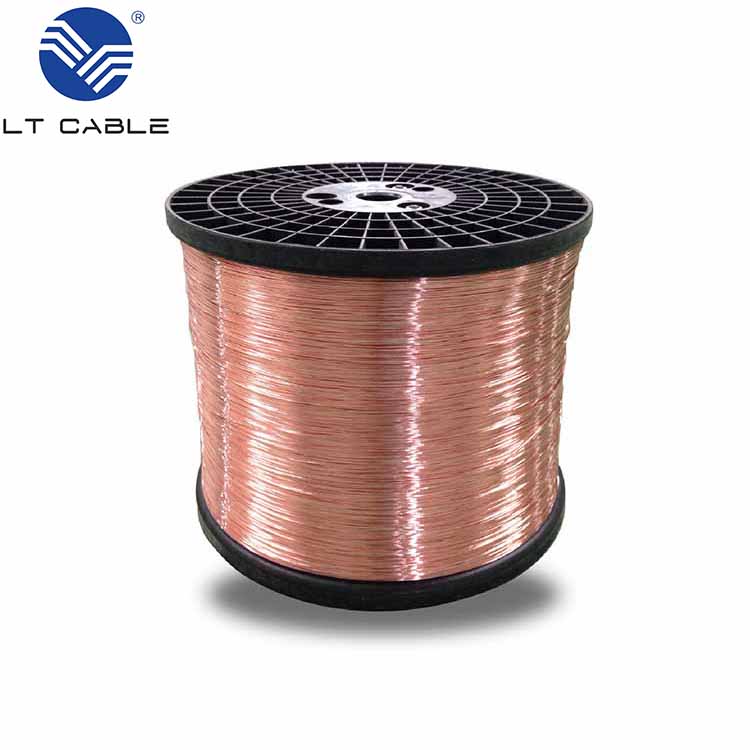
Key Electrical and Mechanical Parameters for Selection
When evaluating potential conductor suppliers, procurement engineers must look beyond basic pricing and focus on specific measurable parameters. The selection process for copper clad aluminum wire for shielded coaxial cable outer braid requires a deep dive into metallurgical and electrical specifications.
Electrical conductivity is typically measured as a percentage of the International Annealed Copper Standard. For high-grade applications, the conductivity generally ranges between 10% and 15% or higher, depending on the volume percentage of copper. Engineers must ensure that the DC resistance matches the specific attenuation requirements of the coaxial cable design. If the resistance is too high, signal loss over long distances will increase exponentially, degrading system performance.
Mechanical characteristics are equally vital during the high-speed braiding process. Coaxial cable manufacturing involves intricate mechanical twisting, weaving, and tensioning. If the wire lacks adequate tensile strength or elongation properties, it will snap during braiding machine operation, leading to costly production downtime. The wire must possess sufficient ductility to bend around tight dielectric cores without fracturing the microscopic copper cladding, which would expose the underlying aluminum to oxidation and galvanic corrosion.
Metallurgical Bonding Quality and International Standards
The manufacturing method of the composite wire dictates its long-term reliability. The two primary production techniques are electroplating and cladding-welding followed by drawing. Cladding-welding creates a permanent, atomic-level metallurgical bond between the aluminum core and the outer copper sheath, preventing delamination during severe bending or thermal cycling.
Adherence to global standards ensures consistency and safety across international supply chains. Procurement teams should verify compliance with specifications such as ASTM B566, which specifically governs copper-clad aluminum wire standards. Other relevant frameworks include IEC standards for electrical conductors and UL safety verifications. These standards test for continuity, coating thickness uniformity, peel strength, and wrapping integrity.
When the metallurgical bond is compromised, microscopic gaps can form between the copper and aluminum layers. Over time, moisture ingress can cause galvanic corrosion, accelerating aluminum oxidation and catastrophic resistance spikes. Therefore, rigorous cross-sectional microscopic examination is an indispensable step in quality control before bulk purchasing.
Comparative Analysis of Outer Braid Conductor Materials
To make an informed procurement decision, engineers often compare composite conductors against traditional solid alternatives. The following table outlines the critical trade-offs between copper clad aluminum wire, bare copper, and tinned copper wire when used in outer shielding braids.
| Conductor Material | Relative Weight | DC Resistance | Tensile Strength | Cost Efficiency | Solderability & Term. |
| Copper Clad Aluminum | Extremely Low | Moderate | High | Excellent | Good (Requires care) |
| Bare Solid Copper | High | Very Low | Moderate | Low | Superior |
| Tinned Copper Wire | High | Low | Moderate | Moderate | Superior |
| Annealed Copper Alloy | Medium | Low | High | Poor | Good |
As illustrated in the comparison table, composite conductors offer a compelling balance of high tensile strength and ultralight weight at a fraction of the cost of solid copper. While solid copper maintains an edge in raw solderability and absolute minimum resistance, the weight savings in aerospace, automotive harnesses, and multi-core data cables make composite options increasingly attractive for modern system architects.
Practical Procurement Pitfalls and Quality Inspection Protocols
Navigating the global supply chain for raw materials presents several hidden traps. One of the most common pitfalls is purchasing substandard wire with uneven copper thickness or off-center aluminum cores. If the copper layer is too thin in localized areas, mechanical stripping or braiding friction can expose the aluminum core, inviting rapid oxidation and signal degradation.
Quality assurance protocols must be firmly established before sealing supplier contracts. Key verification steps include:
Performing dimensional laser micrometers checks to ensure precise wire diameter consistency across entire spools.
Conducting acid immersion or stripping tests to verify the exact volumetric percentage of copper relative to aluminum.
Executing high-tension twist and wrap tests to confirm that the metallic coating does not flake, crack, or peel under physical stress.
Measuring DC resistance with a micro-ohmmeter to validate that electrical performance aligns with certified batch datasheets.
By implementing these strict quality control checkpoints, manufacturers can safeguard their production lines against defective batches. For further insights into advanced shielding solutions and custom engineering specifications, industry professionals can explore resources provided by Litong Cable to optimize their design methodologies and ensure long-term operational reliability in demanding field environments.


