 EN


The Hidden Risks of Sourcing Unverified Bimetallic Conductors
When engineering teams and international procurement specialists issue requests for quotation (RFQs) for bimetallic conductors, they often encounter conflicting technical descriptions and vastly different price points in the global market. Understanding the underlying copper clad aluminum wire difference is paramount for avoiding catastrophic failures in telecommunications, power transmission, and automotive wiring harnesses. A failure to distinguish between superficial surface treatments and genuine metallurgical bonding can result in severe oxidation, high contact resistance, and premature cable degradation in the field.
At
Manufacturing Mechanics: Electrodeposition Versus Cladding
The fundamental performance disparity between these two conductor types stems directly from bimetallic wire manufacturing processes.
Electroplated Conductor Production: Copper plated aluminum wire is typically manufactured using electrochemical deposition or chemical immersion baths. In this setup, an aluminum rod or strand is submerged into a copper salt solution, allowing copper ions to deposit onto the metal surface via an external electrical current. This creates a very thin, superficial layer of copper.
Metallurgical Cladding Production: Conversely, cladding type copper clad aluminum wire is produced through a solid-state metallurgical bonding process. A high-purity electrolytic copper strip is wrapped tightly around an aluminum alloy core rod, followed by sequential multi-pass drawing and high-temperature thermal diffusion annealing. This fuses the copper and aluminum lattices together, forming an unbreakable interatomic bonding zone.
Understanding this core manufacturing variance explains why electroplated variants often exhibit structural weaknesses when subjected to mechanical deformation, whereas true clad wires maintain complete structural integrity under extreme tension.
Electrochemical Performance and Skin Effect Reliability
In high-frequency signal transmission and power distribution, conductor surface integrity directly dictates efficiency. Because alternating current travels primarily along the outer perimeter of a conductor due to the skin effect, the continuity and thickness of the copper layer are critical.
Copper plated aluminum wire features an exceptionally thin copper coating, often measuring only a fraction of a micron or a few micrometers thick. During high-speed cabling, twisting, and outer plastic jacket extrusion, this delicate electroplated layer is highly prone to micro-cracking, scratching, or localized peeling. Once the outer copper barrier is compromised, moisture and atmospheric oxygen directly attack the reactive aluminum core, triggering rapid galvanic corrosion, impedance mismatch, and severe signal attenuation.
On the other hand, cladding type copper clad aluminum wire features a robust copper volume ratio (typically 10 percent to 15 percent of total cross-sectional area) with a substantial, uniform cladding thickness. This thick barrier withstands rigorous mechanical stress during stranding and coiling without exposing the underlying core, ensuring long-term electrical stability and corrosion resistance in demanding environmental conditions.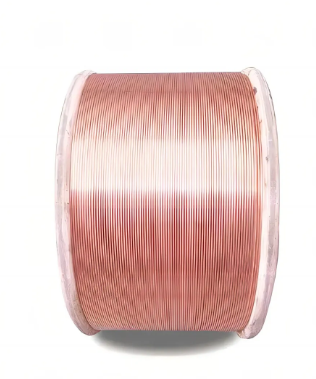
Comprehensive Engineering Parameter Comparison
To assist purchasing managers and quality control engineers in evaluating technical datasheets, the parameter comparison below outlines the exact distinctions across key performance metrics.
| Performance Parameter | Copper Plated Aluminum Wire | Cladding Type Copper Clad Aluminum Wire |
| Copper Layer Thickness | Ultra-thin (0.5 to 3 micrometers) | Substantial (10% to 15% of total radius) |
| Bonding Mechanism | Superficial adhesion via electrodeposition | Permanent interatomic metallurgical diffusion |
| Resistance to Peel & Flaking | Poor; prone to stripping under mechanical stress | Excellent; withstands severe drawing and twisting |
| Corrosion Resistance | Low; micro-pores invite rapid core oxidation | High; continuous copper envelope seals aluminum |
| Primary Industrial Use | Low-cost indoor signal jumpers and patch cords | High-grade coaxial cables, RF lines, and power distribution |
Analyzing this matrix reveals why relying solely on surface appearance can be deceptive. Two spools of wire may appear identical under visual inspection, yet their internal bonding mechanics yield entirely different real-world lifespans.
Practical Inspection and Quality Control Verification Methods
Detecting inferior conductors before mass production requires specialized laboratory inspection protocols. Quality control technicians cannot rely on visual inspection alone, as electroplated finishes often look glossy and uniform right off the production line.
One of the most reliable verification methods for identifying the copper clad aluminum wire difference is the microscopic cross-section analysis utilizing a scanning electron microscope (SEM) or high-magnification optical metallographic microscope. By polishing a cross-section of the wire sample, inspectors can clearly measure the copper layer thickness and inspect the interface boundary. Furthermore, the torsion test and strip-peel test provide immediate mechanical feedback: if bending the wire repeatedly causes the copper coating to flake off like paint, the material is electroplated rather than metallurgically clad.
Procurement teams should always demand mill test reports (MTRs) and commission third-party laboratory verification for bulk orders, ensuring complete compliance with international standards such as ASTM B566.
Safeguarding Your Supply Chain Against Subpar Substitutes
Global supply chain pressures often tempt buyers to prioritize upfront cost savings over technical verification. However, purchasing unverified conductors inevitably leads to higher failure rates, expensive field replacements, and reputational damage for manufacturing brands.
By implementing strict technical specifications that explicitly mandate cladding type copper clad aluminum wire rather than plated alternatives, engineering organizations eliminate ambiguity during supplier bidding. Partnering with reputable manufacturers who maintain transparent factory inspection processes and advanced metallurgical bonding controls ensures absolute reliability.
When sourcing high-performance bimetallic conductors for critical applications, collaborating with trusted industry leaders like


