Dec 24,2025
Copper Clad Aluminum (CCA) wire has an aluminum center wrapped with a thin copper coating. This combination gives us the best of both worlds – the light weight and cost benefits of aluminum plus the good surface properties of copper. The way these materials work together means we get around 60 to 70 percent of what pure copper can do when it comes to conducting electricity according to IACS standards. And this makes a real difference in how well things perform. When conductivity drops, resistance goes up, which leads to wasted energy as heat and bigger voltage losses across circuits. Take for instance a simple setup with 10 meters of 12 AWG wire running 10 amps direct current. Here, CCA wires might show almost double the voltage drop compared to regular copper wires – about 0.8 volts instead of just 0.52 volts. That kind of gap can actually cause problems for delicate equipment such as those used in solar power installations or car electronics where consistent voltage levels are essential.
CCA definitely has its perks in terms of cost and weight, especially for things like LED lights or car parts where production runs aren't huge. But here's the catch: because it conducts electricity worse than regular copper, engineers need to do some serious math on how long those wires can be before they become a fire risk. The thin layer of copper around the aluminum isn't there to boost conductivity at all. Its main job is making sure everything connects properly with standard copper fittings and preventing those nasty corrosion problems between metals. When someone tries passing off CCA as actual copper wire, that's not just misleading customers but actually breaking electrical codes too. The aluminum inside just doesn't handle heat or repeated bending the same way copper does over time. Anyone working with electrical systems really needs to know this stuff upfront, particularly when safety matters more than saving a few bucks on materials.
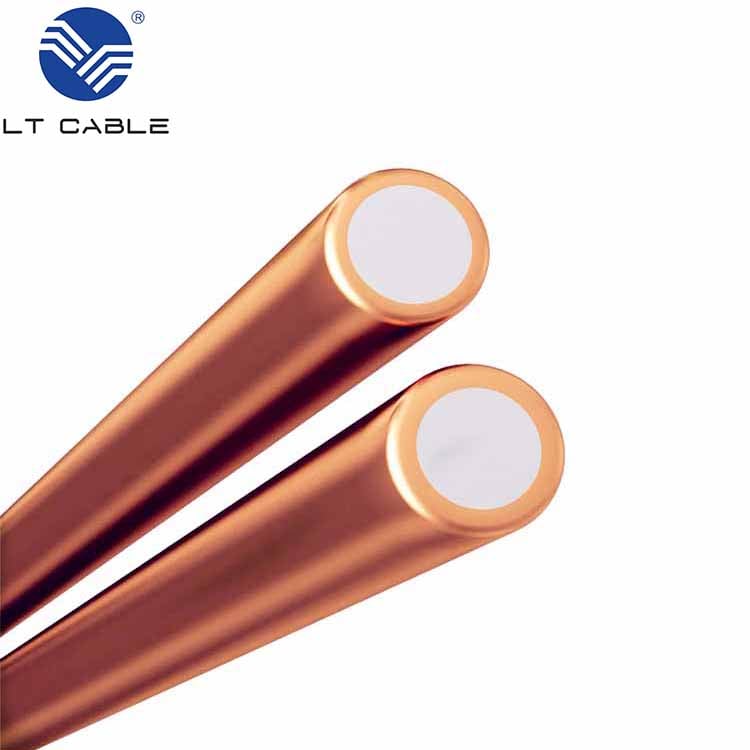
The International Annealed Copper Standard (IACS) benchmarks conductivity against pure copper at 100%. Copper-clad aluminum (CCA) wire achieves only 60–70% IACS due to aluminum’s higher inherent resistivity. While OFC maintains 0.0171 Ω·mm²/m resistivity, CCA ranges between 0.0255–0.0265 Ω·mm²/m—increasing resistance by 55–60%. This gap directly impacts power efficiency:
| Material | IACS Conductivity | Resistivity (Ω·mm²/m) |
|---|---|---|
| Pure Copper (OFC) | 100% | 0.0171 |
| CCA (10% Cu) | 64% | 0.0265 |
| CCA (15% Cu) | 67% | 0.0255 |
Higher resistivity forces CCA to dissipate more energy as heat during transmission, reducing system efficiency—especially in high-load or continuous-duty applications.
Voltage drop exemplifies real-world performance differences. For a 10m DC run with 12 AWG wire carrying 10A:
The 54% higher drop in CCA wire risks triggering under-voltage shutdowns in sensitive DC systems. To match OFC performance, CCA requires either larger gauges or shorter runs—both of which narrow its practical advantage.
CCA wire has some real world benefits when the reduced conductivity isn't such a big deal compared to what we save on costs and weight. The fact that it conducts electricity at about 60 to 70 percent of pure copper matters less for things like low voltage systems, small current flows, or short cable runs. Think about stuff like PoE Class A/B equipment, those LED light strips people put all over their houses, or even car wiring for extra features. Take automotive applications for instance. The fact that CCA weighs around 40 percent less than copper makes a huge difference in vehicle wiring harnesses where every gram counts. And let's face it, most LED installations need tons of cable, so the price difference adds up fast. As long as cables stay under about five meters, the voltage drop stays within acceptable ranges for most applications. This means getting the job done without breaking the bank on expensive OFC materials.
Safety and good performance depend on knowing how far electrical runs can go before voltage drops become problematic. The basic formula goes like this: Maximum Run Length in meters equals Voltage Drop Tolerance multiplied by Conductor Area divided by Current times Resistivity times two. Let's see what happens with a real world example. Take a standard 12V LED setup pulling about 5 amps current. If we allow a 3% voltage drop (which works out to around 0.36 volts), and use 2.5 square millimeter copper clad aluminum wire (with resistivity roughly 0.028 ohms per meter), our calculation would look something like this: (0.36 times 2.5) divided by (5 times 0.028 times 2) gives approximately 3.2 meters as maximum run length. Don't forget to check these numbers against local regulations such as NEC Article 725 for circuits carrying lower power levels. Going beyond what the math suggests can lead to serious problems including wires getting too hot, insulation breaking down over time, or even complete equipment failure. This becomes especially critical when environmental conditions are warmer than normal or multiple cables are bundled together since both situations create extra heat buildup.
Many people think the so called "skin effect" somehow makes up for the issues with CCA's aluminum core. The idea is that at high frequencies, current tends to gather near the surface of conductors. But research shows otherwise. Copper Clad Aluminum actually has about 50-60% more resistance when it comes to direct current compared to solid copper wire because aluminum just isn't as good at conducting electricity. This means there's more voltage drop across the wire and it gets hotter when carrying electrical loads. For Power over Ethernet setups this becomes a real problem since they need to deliver both data and power through the same cables while keeping things cool enough to avoid damage.
There's another common misunderstanding about oxygen free copper (OFC). Sure, OFC has around 99.95% purity compared to regular ETP copper at 99.90%, but the actual difference in conductivity isn't that big – we're talking about less than 1% better on the IACS scale. When it comes to composite conductors (CCA), the real issue isn't the copper quality at all. The problem stems from the aluminum base material used in these composites. What makes OFC worth considering for some applications is actually its ability to resist corrosion much better than standard copper, especially in harsh conditions. This property matters far more in practical situations than those tiny conductivity improvements over ETP copper ever will.
| Factor | CCA Wire | Pure Copper (OFC/ETP) |
|---|---|---|
| Conductivity | 61% IACS (aluminum core) | 100–101% IACS |
| Cost Savings | 30–40% lower material cost | Higher base cost |
| Key Limitations | Oxidation risk, PoE incompatibility | Minimal conductivity gain vs. ETP |
Ultimately, CCA wire’s performance gaps stem from fundamental aluminum properties—not remediable through copper cladding thickness or oxygen-free variants. Specifiers should prioritize application requirements over purity marketing when evaluating CCA viability.

Tailored advice, perfect fit solutions.

Efficient manufacturing, seamless supply.

Rigorous testing, global certifications.

Prompt assistance, ongoing support.
 EN
EN