 EN
EN

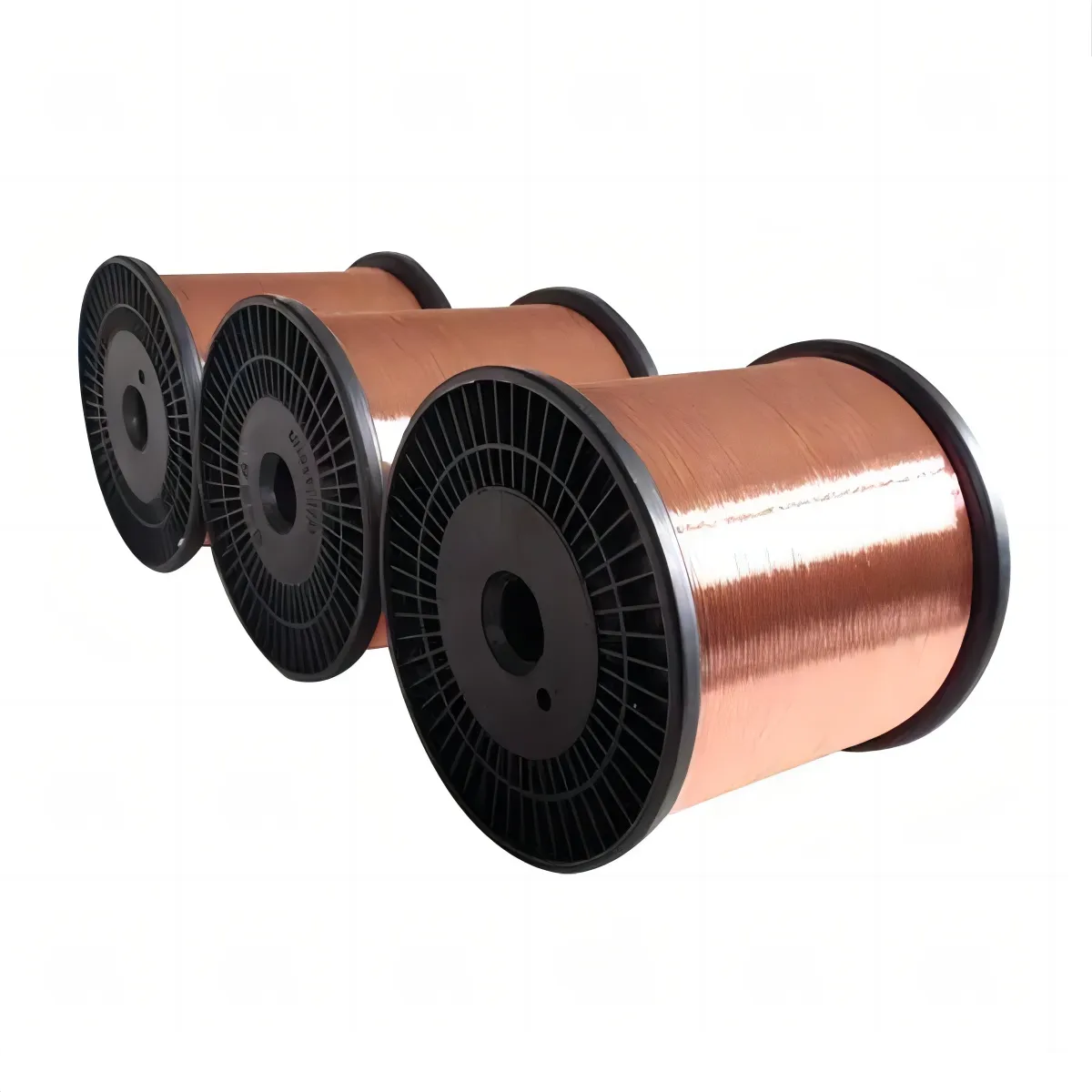
Why Stranded CCA Wire Excels in Flexible Cable Applications
Stranded CCA wire combines the lightweight benefit of aluminum with the surface conductivity of copper, making it ideal for flexible cable designs. Its multiple fine strands distribute mechanical stress evenly during bending—reducing localized fatigue and extending service life in dynamic applications like robotics, portable electronics, and automotive wiring. Compared to solid copper, it offers up to 40% weight savings, easing installation in tight or moving spaces. While its DC resistance is higher than copper’s, the reduced weight and enhanced flexibility often outweigh this trade-off for medium-current and signal applications. Stranding also improves resistance to vibration and shock—critical for equipment under constant motion. For manufacturers seeking a cost-effective yet reliable conductor, stranded CCA delivers balanced performance aligned with modern flexible cable requirements.
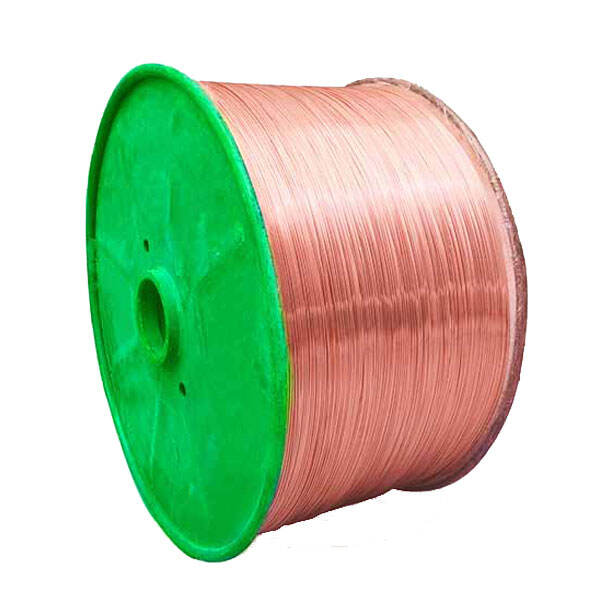
Mechanical Durability: Bend Life, Fatigue Resistance, and Brittleness Mitigation
Stranded CCA wire must withstand repetitive bending without premature failure. Its mechanical endurance hinges on bend-radius limits and the fatigue resistance conferred by fine stranding.
Bend Radius Limits and Class 5 Flex-Life Performance Per IEC 60228
IEC 60228 defines Class 5 as the standard for highly flexible conductors, specifying minimum bend radii to prevent excessive strain on individual strands. For stranded CCA wire, the recommended bend radius is typically 6–8× the cable’s outer diameter. Exceeding this limit accelerates work hardening and shortens flex life. When properly manufactured and tested per IEC 60228, stranded CCA achieves over 10 million flex cycles in controlled conditions—matching pure copper performance in many low-voltage, low-stress applications.
How Stranding Reduces Microcracking and Extends Fatigue Resistance Under Dynamic Load
Microcracking begins when tensile stress concentrates at grain boundaries. By dividing the conductor into many fine strands (e.g., 34 AWG or finer), stranding distributes load across numerous interfaces—lowering peak stress at any single point. It also provides a “crack-arrest” effect: a crack in one strand rarely propagates to adjacent strands. This preserves electrical continuity longer under cyclic bending, making stranded CCA well-suited for cable carriers, robotic arms, and other high-motion environments.
Electrical and Termination Reliability of Stranded CCA Wire
Oxidation kinetics at strand interfaces and thermal-cycle stability of crimped terminations
Stranded CCA presents a unique oxidation challenge at the copper-clad/aluminum-core interface. Micro-gaps between strands can admit moisture, accelerating galvanic corrosion—especially under repeated thermal cycling. UL 486A test data show that after 500–1,000 cycles from −40°C to +85°C, oxide growth at strand boundaries reaches 30–50 nm, increasing contact resistance at crimped terminations by 15–20%. High-quality cladding processes—ensuring a uniform copper layer ≥10 μm thick—significantly slow this oxidation. Likewise, precision crimp dies with controlled compression ratios (10–15% reduction) minimize micro-gap formation, maintaining thermal-cycle stability within ±5% resistance shift—a key requirement for industrial control panels and automotive auxiliary cables.
DC resistance drift, PoE power delivery limits, and signal integrity trade-offs vs. pure copper
Aluminum’s resistivity is 62% higher than copper’s, so an equivalent-gauge stranded CCA conductor exhibits 1.2–1.5× the DC resistance of pure copper. Over time, joint oxidation and thermal aging can cause additional resistance drift of 3–8% after 10,000 hours at rated current—a phenomenon more pronounced in CCA than in copper. This drift directly constrains Power over Ethernet (PoE) use: a typical 23 AWG stranded CCA link exceeds the 1.0 Ω voltage-drop limit beyond 60 m, rendering it unsuitable for PoE++ (60 W) deployments. For high-speed data, the higher resistance erodes eye diagram margins above 1 Gbps, while stranding offers only marginal improvement in skin-effect losses—Litz wire remains superior for RF or high-frequency applications. As a practical guideline, stranded CCA is best applied in low-power signal transmission (<15 W) or short-distance power delivery where long-term resistance stability is less critical.
FAQ
What is Stranded CCA wire?
Stranded CCA wire is a conductor made of multiple fine strands of copper-clad aluminum, combining the lightweight property of aluminum with the conductivity of copper.
Why is Stranded CCA wire suitable for flexible cable applications?
The fine stranding in stranded CCA wire distributes mechanical stress evenly during bending, reducing fatigue and increasing durability in applications requiring flexibility.
How does stranded CCA wire compare to solid copper in weight and resistance?
Stranded CCA wire provides up to 40% weight savings compared to solid copper, though it does have higher DC resistance.
What are the electrical limitations of stranded CCA wire?
Stranded CCA wire has higher DC resistance and is unsuitable for long-distance power delivery in Power over Ethernet applications or high-speed data transmission.
How does stranded CCA wire resist fatigue and microcracking?
Stranding reduces tensile stress at grain boundaries, preventing microcracking and ensuring longer service life in dynamic applications.


