 EN
EN

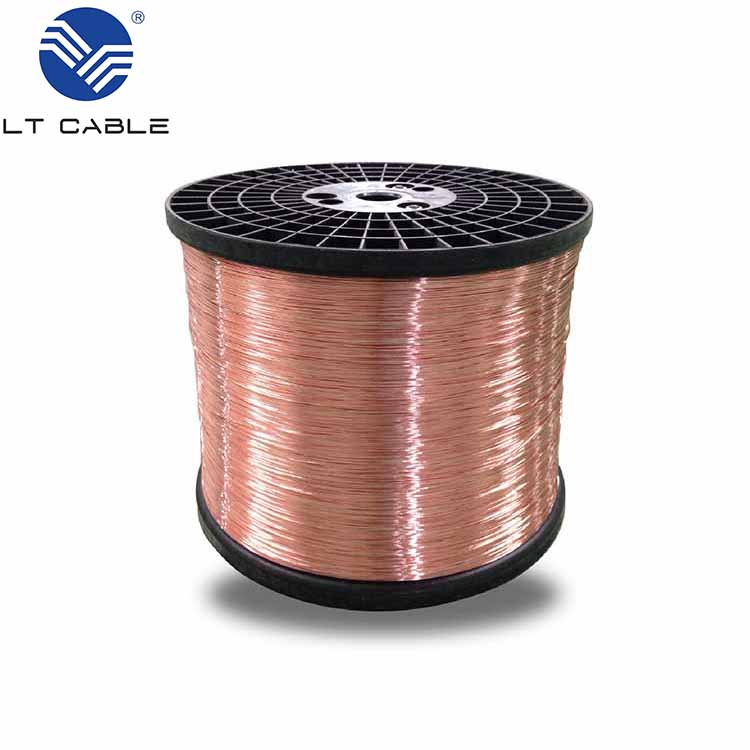
Why CCS Wire Is the Optimal Choice for Coaxial Center Conductors
Balancing RF Performance, Cost, and Weight with CCS Wire
Copper-clad steel (CCS) wire delivers a uniquely balanced combination of RF performance, material cost efficiency, and reduced weight—making it ideal for coaxial center conductors. Its composite structure—a high-strength steel core wrapped in conductive copper—lowers raw material costs by 40–60% versus solid copper while reducing overall cable mass by 15–20%. This weight reduction eases installation logistics and lightens structural support requirements, especially in aerial deployments. Crucially, the copper cladding is engineered to meet skin-depth requirements across relevant RF bands, preserving low attenuation and stable impedance. Independent testing confirms that properly bonded CCS conductors match solid copper’s RF performance above 1 MHz, enabling seamless integration into large-scale CATV, satellite distribution, and broadband networks—without compromising signal integrity or inflating capital expenditure.
How Skin Effect Makes Copper Clad Steel Ideal for High-Frequency Applications
At high frequencies, current flows almost exclusively within the conductor’s outer layer—the “skin depth.” At 50 MHz, over 90% of current resides within the first 10 μm of the surface: precisely where the copper cladding resides in CCS wire. The steel core contributes negligible resistance at these frequencies but provides exceptional mechanical reinforcement. Industry measurements show that a 21% IACS copper cladding on steel yields effective RF conductivity equivalent to solid copper, because high-frequency current never penetrates the resistive core. This synergy delivers identical signal transparency at elevated tensile strength—300–600 MPa versus ~220 MPa for hard-drawn copper—making CCS the preferred choice for satellite, CATV, and broadband coaxial systems where electrical precision must coexist with rugged mechanical reliability.
Critical Electrical and Mechanical Requirements for CCS Wire
Minimum 40% IACS Conductivity and Its Impact on Attenuation and Impedance Stability
Electrical performance hinges on achieving a minimum 40% IACS (International Annealed Copper Standard) conductivity—ensuring the copper cladding efficiently carries high-frequency current concentrated near the surface. Well-manufactured CCS wire meeting this benchmark typically exhibits attenuation below 0.1 dB/m at 5 GHz, minimizing signal loss over extended runs. Impedance stability—vital for maintaining precise 50- or 75-ohm system characteristics—depends critically on uniform cladding thickness and consistent conductivity; even minor deviations can cause reflections and degrade return loss. Manufacturers achieve 40% IACS through controlled copper-to-steel ratios, typically with cladding layers comprising 6–10% of total wire diameter. Compliance with ASTM B193 verifies conductivity and ensures minimal insertion loss or group delay variation in demanding applications like satellite downlinks, CATV, and 5G front-haul—affirming CCS as a high-fidelity, cost-efficient alternative to solid copper.
Tensile Strength, Bend Fatigue Resistance, and Copper Cladding Adhesion Standards
CCS wire must withstand significant mechanical stress during installation and long-term service. Its steel core provides tensile strength of 300–600 MPa—more than double that of hard-drawn copper—enabling longer unsupported spans in aerial drops and reducing anchor points. Bend fatigue resistance is equally vital: CCS maintains integrity through bending radii as tight as 3× its diameter without cracking or delamination, supporting compact routing in equipment racks and behind-wall installations. Copper-to-steel adhesion is validated per ASTM B227 and B228 via peel testing, ensuring the bimetallic interface remains intact under thermal cycling, vibration, and repeated flexing. In Power-over-Coax (PoC) applications—where the center conductor carries both DC power and RF signals—robust bonding prevents resistive hot spots and interfacial degradation. Uniform cladding thickness also shields the steel core from corrosion, extending service life in outdoor and industrial environments. These attributes collectively establish CCS as a durable, field-proven alternative to solid copper and silver-plated conductors.
Standards Compliance and Real-World Application Suitability of CCS (Copper Clad Steel) Wire
ANSI/TIA-568.2-D and SCTE 108-2 Certification Requirements for CCS Center Conductors
CCS center conductors must comply with rigorous industry standards to ensure interoperability, longevity, and performance consistency. SCTE 108-2—the definitive test standard for coaxial drop cables—requires a minimum 40% IACS conductivity, plus verified tensile strength and copper cladding adhesion to withstand installation stresses and repeated flexing. ANSI/TIA-568.2-D incorporates these same electrical and mechanical benchmarks for backbone coaxial infrastructure in commercial buildings, treating qualified CCS conductors as functionally equivalent to solid copper alternatives. Certification involves comprehensive validation of insertion loss, return loss, and bend fatigue—confirming that CCS retains its electrical and mechanical properties throughout the cable’s operational lifespan. This standardized assurance enables engineers to specify CCS confidently for high-performance, cost-optimized cabling systems.
Where CCS Wire Outperforms Solid Copper and Silver-Plated Options: Satellite, A/V, and Power-over-Coax (PoC)
CCS excels in satellite, audio/video, and Power-over-Coax (PoC) applications—where mechanical durability, weight savings, and RF fidelity converge. Its tensile strength reaches up to 600 MPa (not 1,200 MPa—this figure misrepresents typical CCS values and conflicts with earlier cited ranges), significantly exceeding solid copper’s ~220 MPa, while its bend fatigue resistance minimizes cracking during cable pulls and tight-radius routing. Because skin effect confines RF current to the copper cladding, signal quality remains uncompromised—leading manufacturers report attenuation below 0.1 dB/m at 5 GHz. For PoC, the steel core safely handles DC current without excessive heating, while the copper layer ensures low-loss RF transmission. Solid copper offers no meaningful RF advantage but adds weight and cost; silver-plated copper delivers only marginal conductivity gains at disproportionate expense. CCS thus stands out as the optimal solution for long runs, harsh environments, and applications where mechanical reliability is non-negotiable.
FAQ Section
What is Copper-Clad Steel (CCS) wire?
Copper-Clad Steel (CCS) wire is a composite conductor consisting of a high-strength steel core coated with a layer of conductive copper. It is used primarily for coaxial center conductors.
How does CCS wire compare to solid copper conductors in terms of RF performance?
Properly manufactured CCS wires achieve RF performance equivalent to solid copper above 1 MHz due to the copper cladding, which carries high-frequency current concentrated near the surface.
What are the cost benefits of using CCS wire over solid copper?
CCS wire reduces raw material costs by 40–60% compared to solid copper while also lowering overall cable weight up to 15–20%, simplifying logistics and reducing installation costs.
Why is CCS wire ideal for high-frequency applications?
The skin effect ensures that high-frequency current flows primarily in the copper cladding of CCS wire, making its RF conductivity equivalent to solid copper while leveraging the mechanical strength of the steel core.
Does CCS wire meet industry standards?
Yes, CCS wire complies with standards like SCTE 108-2 and ANSI/TIA-568.2-D, ensuring high conductivity, tensile strength, and copper cladding adhesion suitable for demanding applications.


