 EN
EN

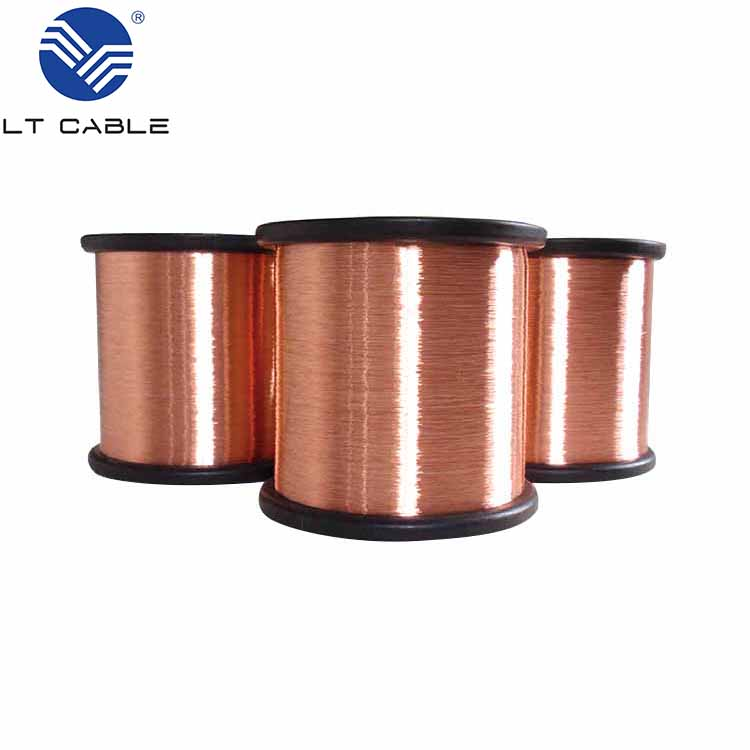
What Is CCS Wire and How Does It Differ from Standard Cabling?
Core Construction and Voltage/Current Ratings for CCS Applications
CCS (Copper Clad Steel) wire is a bi-metallic conductor formed by metallurgically bonding a copper cladding to a low-carbon steel core. Most CCS designed for electrical applications achieves 40% IACS (International Annealed Copper Standard) conductivity. For DC circuits, its combined resistance is typically 15–30% higher than solid copper of the same diameter—dependent on cladding thickness—while at high-frequency AC, the skin effect concentrates current in the outer copper layer, making performance nearly equivalent to pure copper. Voltage ratings are determined by the insulation system (e.g., cross-linked polyethylene or silicone), commonly reaching up to 600 V or 1 kV. Continuous-current capacity follows standard ampacity tables based on conductor cross-section and allowable temperature rise. Mechanically, CCS excels: tensile strength ranges from 550–700 MPa—roughly triple that of pure copper (210–250 MPa, per Material Science Review tests)—and bend-life endurance exceeds copper by threefold under ASTM B470 flex testing.
Key Differences Between CCS Wire and Traditional Automotive or Power Cables
Traditional automotive cables use stranded pure copper, offering superior raw conductivity but limited tensile strength and higher weight. CCS reverses that trade-off: its steel core reduces weight by ~30% versus an equivalent solid-copper conductor, simplifies installation over long runs, and resists stretching 40% better under load. Tight-radius pulls that risk snapping copper are handled reliably, and its superior flex life is especially valuable in high-vibration environments such as EV onboard chargers and DC fast-charging cabinets. Electrically, the modest 15–30% increase in DC resistance must be accounted for when sizing cables for high-power applications (e.g., 150 kW or 350 kW) to avoid excess heating; however, mechanical robustness and lower material cost often justify a single-gauge upsize. In contrast, pure-copper cables require more frequent supports and reinforcement in dynamic or harsh installations—making CCS a balanced solution for industrial and EV charging applications where durability, weight savings, and acceptable conductivity converge.
Critical Applications of CCS Wire in EV Charging Infrastructure
CCS wire forms the backbone of electric vehicle high-power connectivity, engineered to handle both AC and DC charging within a single integrated system. Its design directly influences charging speed, safety, and long-term reliability across public and private infrastructure.
Integration in Combined Charging System (CCS) Connectors and Cables
CCS connectors—which held a 34.6% share of the global EV battery connector market in 2024—combine traditional AC pins with two dedicated DC power contacts, enabling a single port to support Level 2 home charging and ultra-fast DC sessions up to 350 kW. The internal wiring must withstand repeated flexing, wide temperature swings, and high currents without degradation. Specialized cross-linked polyethylene (XLPE) insulation and finely stranded conductors balance flexibility with thermal resilience. Integrated shielding and precise gauge selection (often 4 AWG to 2/0 AWG for DC paths) prevent electromagnetic interference and resistive heating, ensuring stable communication protocols and power delivery over thousands of plug-unplug cycles.
Role in DC Fast Charging Stations and Onboard Chargers
In DC fast-charging installations, CCS wire carries continuous currents of 300–500 A from the power cabinet to the vehicle—frequently through liquid-cooled cables that mitigate heat buildup. This enables a 350 kW charger to replenish an EV battery from 10% to 80% in under 30 minutes. The wire bypasses the onboard charger entirely, feeding direct current straight to the traction battery via the CCS inlet. Automakers therefore require the onboard wiring—from inlet to battery contactors—to meet the same extreme specifications: high flex life, flame retardancy per UL 62, and insulation resistance against thermal runaway. The result is a seamless chain of components that maintains safety and performance even under peak-load, continuous-duty cycles at public charging hubs.
Key Technical Specifications and Compliance Standards for CCS Wire
UL 62, ISO 6722‑2, and EN 50620 Certification Requirements
CCS wire must comply with a narrow set of international standards to guarantee electrical safety and mechanical durability in EV charging systems. UL 62 governs flexible cord and cable construction, including minimum insulation thickness and temperature rating. ISO 6722‑2 specifies abrasion resistance, voltage classes (60 V and 600 V), and long-term aging behavior for single-core automotive cables. EN 50620 defines test regimes for charging cables up to 1,000 V AC and 1,500 V DC, mandating successful conductor bond integrity and voltage withstand assessments. Adherence to these certifications verifies reliable performance under the mechanical and electrical stresses typical of fast-charge duty cycles.
Thermal Performance, Flex Life, and Flame Retardancy Under High‑Load Conditions
Under continuous high-current operation, CCS wire relies on insulation systems that maintain dielectric strength across a wide temperature span. Certified cables routinely support continuous service from –40 °C to +85 °C, with intermittent peaks above 105 °C when using cross-linked polyethylene (XLPE) or silicone compounds. These materials also deliver strong flame retardancy, typically passing UL VW-1 or IEC 60332-1-2 vertical flame tests. Flex life is equally critical: qualified designs withstand more than 10,000 bend cycles at tight bending radii without cracking or resistance drift. The steel core’s high tensile strength permits thinner-gauge construction while preserving conductivity—reducing I²R heat buildup during 350 kW charging and extending service life in dynamic installations.
How to Select the Right CCS Wire for Your B2B Application
Selecting the right CCS wire means matching cable specs to charging power demands while verifying supplier quality. A structured approach avoids costly mismatches in high-power EV infrastructure.
Matching Gauge, Insulation Type, and Shielding to Charging Power Levels (e.g., 150 kW vs. 350 kW)
Higher charging power requires larger conductor cross-sections to manage current without excessive voltage drop or heat. A 150 kW system often uses ~95 mm² gauge, while a 350 kW system may demand 120 mm² or more—with liquid-cooled cables becoming necessary to maintain safe operating temperatures. Insulation must withstand elevated voltages (typically 1 kV or higher) and harsh environmental conditions; silicone or cross-linked polyethylene is common. Shielding becomes critical at higher power to suppress electromagnetic interference, protecting communication lines between the vehicle and charger. Pairing gauge, insulation class, and shield effectiveness with the target power level ensures durability and compliance with performance standards.
Supplier Qualification Checklist: Traceability, RoHS/REACH Compliance, and OEM Approval
A thorough supplier evaluation reduces risk of field failures and regulatory headaches. Key verification points include:
- Full batch-level traceability for raw materials and finished cable
- RoHS and REACH compliance documented by third-party test reports
- OEM approvals (e.g., IATF 16949 certification) and references from major EVSE manufacturers
- In-house testing capabilities for conductivity, insulation resistance, and flame retardancy
- Provision of certified dimensional and electrical data sheets with each shipment
Cross-checking these items before contracting guarantees that the CCS wire meets both technical and environmental demands of modern DC fast charging.
FAQs
What is CCS wire made of?
CCS wire is composed of a low-carbon steel core metallurgically bonded with a copper cladding, creating a bi-metallic conductor that balances conductivity and mechanical strength.
How does CCS wire perform electrically compared to pure copper?
For DC circuits, CCS wire exhibits 15–30% higher resistance than pure copper. However, at high-frequency AC, the skin effect enables performance nearly equivalent to pure copper.
What are the key applications of CCS wire in EV charging systems?
CCS wire is used in EV charging systems such as connectors, onboard chargers, and DC fast chargers. It maintains safety and performance under high-load conditions while supporting high-power delivery up to 350 kW.
What standards must CCS wire comply with for safe EV use?
CCS wire must comply with UL 62, ISO 6722-2, and EN 50620 standards to ensure electrical safety, mechanical durability, and flame retardancy in EV systems.
How do I select the right CCS wire for my EV charging application?
Selection involves matching cable specs such as gauge, insulation type, and shielding to the system's power demands while verifying supplier quality and certification adherence.


