 EN
EN

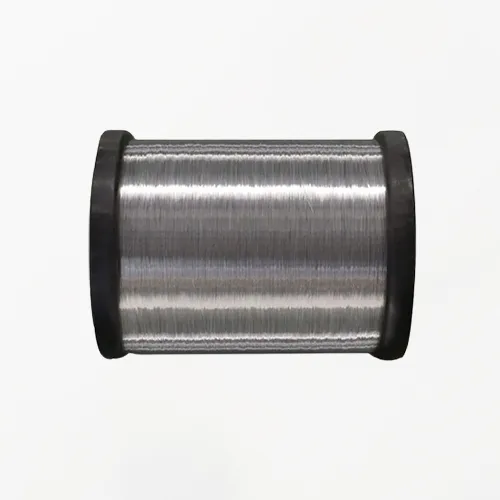
CCAM Alloy Fundamentals: Balancing Conductivity, Strength, and Processability
Composition and IACS Performance of CCAM vs. ETP, OFHC, and CDA 110
CCAM (Copper Clad Aluminum Magnesium) wire is a composite conductor comprising a high-purity aluminum core (typically 1350 series) bonded to a copper cladding layer. The cladding volume fraction is engineered to meet ASTM B566’s minimum 10% copper requirement, delivering a nominal conductivity of 65% IACS—a deliberate compromise between electrical performance and mechanical robustness. In contrast, ETP copper (CDA 110) and OFHC copper achieve 100% and 101% IACS, respectively, but at nearly triple the density (8.9 g/cm³ vs. 2.7 g/cm³ for aluminum). This 3:1 weight advantage makes tinned CCAM (tCCAM) especially valuable in automotive and aerospace harnesses, where mass reduction directly improves fuel efficiency and system agility. While its IACS is lower, CCAM’s conductivity remains fully adequate for signal and power distribution circuits up to 50 A. The tin coating further enhances long-term oxidation resistance without meaningfully degrading bulk conductivity.
How Fe, P, and Ni Enhance Tensile Strength and Crimp Retention Without Sacrificing Solderability
Trace additions of iron (Fe), phosphorus (P), and nickel (Ni) to the copper cladding refine grain structure and promote fine intermetallic precipitates that impede dislocation motion—raising tensile strength by 15–30% over unalloyed copper. This strengthening is essential for crimp retention: it prevents plastic deformation under terminal compression, maintaining gas-tight, low-resistance connections through thousands of thermal cycles. Crucially, these alloying elements do not impair solderability. The electroplated or hot-dipped tin layer on tCCAM provides a consistently wettable surface, and the controlled precipitate distribution avoids excessive intermetallic growth that could undermine joint integrity. As a result, tCCAM supports standard soldering processes while delivering superior durability in high-vibration environments—including engine compartments and industrial control systems.
Tin Coating Specifications for Reliable tCCAM Wire Performance
Optimal Tin Thickness (3–15 µm): Oxidation Resistance, Solder Wetting, and Shelf-Life Trade-offs
The functional performance of tCCAM wire depends critically on precise tin thickness control—typically 3–15 µm—to balance oxidation resistance, solder wetting, and mechanical flexibility. Coatings below 3 µm often contain micro-porosity, exposing the copper-clad core to oxygen and moisture and accelerating oxidation. Industry data shows that a minimum of 5 µm is required to sustain reliable solder wetting over a 12-month shelf life under controlled storage conditions. For marine or high-humidity applications, where copper-oxide formation risk is elevated, coatings of 10–15 µm offer superior corrosion protection. However, thicknesses approaching 15 µm increase stiffness and weight, potentially complicating crimp termination and reducing bend compliance. For most automotive and industrial harnesses, the optimal range is 8–12 µm: thick enough to withstand repeated thermal cycling without dewetting, yet thin enough to preserve flexibility and ensure uniform solder flow—minimizing cold joints and flux entrapment during assembly.
Intermetallic Layer Control (Cu₆Sn₅/Cu₃Sn): Managing Growth During Storage and Thermal Cycling
A thin intermetallic compound (IMC) layer—primarily Cu₆Sn₅, evolving into Cu₃Sn over time—forms naturally at the copper–tin interface after tinning. While essential for metallurgical bonding and initial solderability, uncontrolled IMC growth compromises reliability. Elevated ambient temperatures accelerate diffusion, causing the IMC to thicken beyond 2 µm, consuming the tin reservoir and creating a brittle interface prone to cracking under thermal-mechanical stress. This effect is amplified in CCAM due to the aluminum-magnesium core’s higher coefficient of thermal expansion. Accelerated life testing confirms that limiting pre-soldering IMC thickness to <2 µm ensures joint integrity across 1,000+ thermal cycles. Mitigation strategies include specifying pure tin with an optional nickel barrier (where permitted), storing reels in climate-controlled environments (<30 °C), and implementing strict inventory rotation. These practices maintain a favorable Cu₆Sn₅/Cu₃Sn ratio and preserve the solderability critical to long-life tCCAM interconnections.
Tin Application Method Selection: Hot-Dip vs. Electroplating for tCCAM Wire
Selecting the tin application method for tCCAM wire directly influences conductivity retention, solderability consistency, and field reliability. Hot-dip tinning immerses the wire in molten tin, forming a metallurgically bonded layer typically 5–15 µm thick. It delivers excellent adhesion and strain tolerance—ideal for automotive harnesses and heavy-duty industrial cables subjected to flexing or aggressive crimping. Electroplating, by contrast, deposits tin ion-by-ion in a controlled bath, yielding highly uniform, smooth coatings of 3–8 µm. Its precision benefits high-density connectors and fine-pitch terminations where consistent contact resistance and low insertion force are essential.
| Attribute | Hot‑Dip Tinning | Electroplating |
|---|---|---|
| Typical tin thickness | 5–15 µm | 3–8 µm |
| Coating uniformity | Moderate; slight thickness variation along length | Excellent; highly consistent across the surface |
| Adhesion mechanism | Intermetallic formation (Cu₆Sn₅/Cu₃Sn) at the interface | Diffusion‑driven bond; may require post‑plating heat treatment to strengthen |
| Surface finish | Matte, may show minor flow marks | Bright, smooth, and visually appealing |
| Flex / strain tolerance | High; coating resists flaking under repeated bending | Moderate; very thin layers can crack if not properly bonded |
| Solderability | Good, with a thicker tin reservoir for wetting | Excellent; consistent, oxide‑free surface ensures rapid wetting |
| Cost for high volumes | Lower raw material cost but higher energy consumption | Higher equipment and chemical costs; more economical for thin, precision coatings |
Hot-dip tinning inherently forms a more developed Cu₆Sn₅/Cu₃Sn intermetallic zone, which aids adhesion but requires careful management to avoid brittleness. Electroplated coatings begin with a thinner IMC, allowing tighter control over growth during storage or thermal cycling—particularly valuable given the aluminum core’s sensitivity to prolonged heat exposure. For tCCAM, electroplating’s lower thermal input helps preserve core strength and conductivity. Ultimately, the choice must align with the target application standard—such as ISO 6722 for road vehicles, which permits either method if thickness and adhesion requirements are met—and prioritize lifecycle reliability over initial cost.
Standards Compliance and Certification for tCCAM Wire in Critical Applications
Automotive (ISO 6722-1/-2), UL 1581, and MIL-DTL-16878E Requirements for tCCAM Construction and Testing
Automotive and defense applications demand tCCAM wire certified to stringent construction and performance standards. ISO 6722-1 (60 V) and -2 (600 V) define dimensional tolerances, insulation requirements, and mechanical properties—including tensile strength, elongation, and resistance to vibration and thermal cycling—ensuring the copper cladding and tin layer remain intact during crimping and service life. UL 1581 verifies safety-critical attributes such as flame resistance (VW-1 vertical flame test), cold bend performance, heat shock resilience, and insulation deformation resistance. MIL-DTL-16878E adds rigorous electrical and physical limits—voltage withstand, insulation resistance, and accelerated aging—for military-grade hook-up wire. Under all three standards, tCCAM must demonstrate stable conductivity, consistent solderability, and robust pull-off strength. Compliance is validated through type-test reports and lot-by-lot inspection, confirming suitability for mission-critical locations including engine bays, chassis harnesses, and avionics systems.
RoHS/REACH, Nickel Barrier Use, and Traceability for High-Reliability tCCAM Supply Chains
High-reliability tCCAM wire must comply with RoHS and REACH regulations, prohibiting restricted substances—including lead, mercury, and cadmium—in both tin coating and insulation. To extend solderability in long-storage or thermally aged applications, a nickel barrier layer is commonly applied between the copper cladding and tin finish. This barrier suppresses rapid Cu₆Sn₅/Cu₃Sn intermetallic growth, preserving joint ductility and wetting performance over time. Equally vital is full supply-chain traceability: reputable suppliers provide lot-specific certifications linking each reel to the source aluminum alloy, cladding process parameters, and tin plating bath records. Such traceability—often supported by ISO 9001-certified quality management—enables rapid root-cause analysis should performance deviations arise. Together, regulatory compliance, engineered barrier layers, and auditable traceability reduce field-failure risk in aerospace, medical, and defense systems, where component integrity is inseparable from operational safety and readiness.
FAQs
What is the primary advantage of CCAM wire over pure copper conductors?
CCAM wire delivers a significant weight advantage (3:1) compared to pure copper conductors, making it ideal for automotive and aerospace applications where reduced mass improves fuel efficiency and agility.
Why is tin coating critical for tCCAM wire performance?
Tin coating enhances oxidation resistance, improves solderability, and extends the shelf life of tCCAM wire by protecting the copper cladding from moisture and oxygen exposure.
How does the addition of Fe, P, and Ni affect CCAM wire strength?
These elements refine the copper grain structure and promote intermetallic precipitates, strengthening tensile capacity and crimp retention while preserving solderability.
What are the differences between hot-dip tinning and electroplating for tCCAM wires?
Hot-dip tinning produces thicker layers with greater flex tolerance, while electroplating yields more uniform and thinner coatings optimal for high-density connectors.
What certifications must tCCAM wire meet to be used in critical applications?
tCCAM wire must comply with standards like ISO 6722 (automotive), UL 1581 (safety-critical attributes), and MIL-DTL-16878E (military-grade requirements) to ensure reliability and performance.
Table of Contents
- CCAM Alloy Fundamentals: Balancing Conductivity, Strength, and Processability
- Tin Coating Specifications for Reliable tCCAM Wire Performance
- Tin Application Method Selection: Hot-Dip vs. Electroplating for tCCAM Wire
- Standards Compliance and Certification for tCCAM Wire in Critical Applications
-
FAQs
- What is the primary advantage of CCAM wire over pure copper conductors?
- Why is tin coating critical for tCCAM wire performance?
- How does the addition of Fe, P, and Ni affect CCAM wire strength?
- What are the differences between hot-dip tinning and electroplating for tCCAM wires?
- What certifications must tCCAM wire meet to be used in critical applications?


