 EN
EN

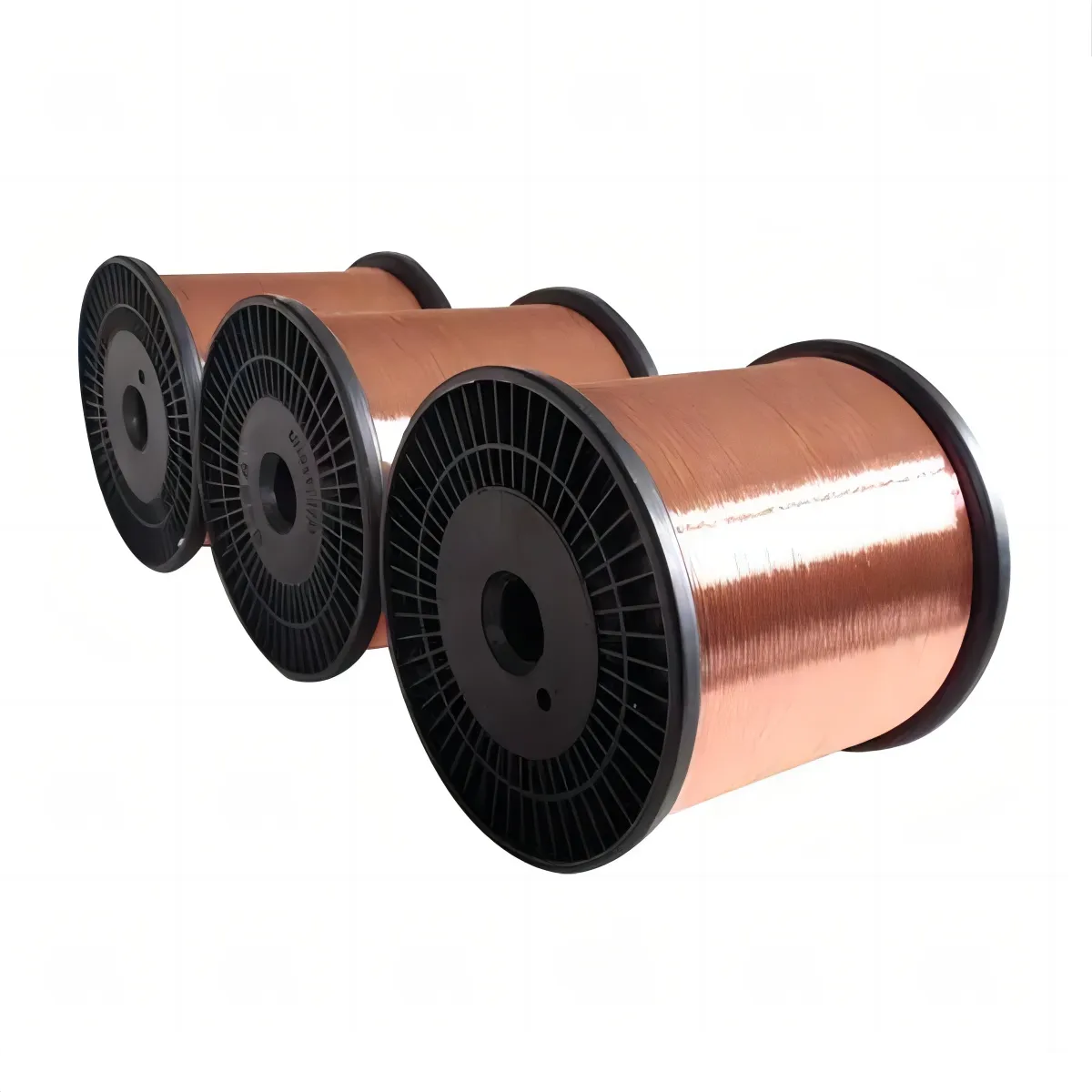
Why TCCAM Wire Is Optimal for High-Performance Braided Shielding
Material synergy: Copper-clad aluminum-magnesium core delivers conductivity, strength, and weight savings
The copper-clad aluminum-magnesium (CCAM) core of TCCAM wire uniquely balances electrical performance, mechanical robustness, and mass efficiency—critical for high-performance braided shielding. A thin copper cladding (10–15% of cross-sectional area) provides a low-resistance path for surface currents, achieving 60–70% IACS conductivity. Meanwhile, the aluminum-magnesium alloy core reduces weight by ~40% versus solid copper—delivering measurable gains in fuel efficiency and payload capacity for aerospace and automotive systems. Mechanically, the alloy’s tensile strength (200–250 MPa) resists strand breakage during high-speed braiding and repeated flexing, preserving shield continuity. This combination enables consistent EMI attenuation without the mass penalty of pure copper, establishing TCCAM as the preferred material for lightweight, mission-critical shielding.
Tin plating’s triple advantage: Corrosion resistance, solderability, and reduced inter-strand friction
A uniform tin coating over the copper cladding delivers three interdependent benefits essential to long-term shield reliability. First, it acts as a sacrificial barrier against oxidation and galvanic corrosion in humid, saline, or chemically aggressive environments—extending service life in marine, outdoor, and industrial applications. Second, tin’s excellent wettability with standard lead-free and SnPb solders simplifies termination, enabling low-resistance joints without aggressive fluxes or excessive thermal input. Third, the soft tin layer serves as an effective solid lubricant between strands, minimizing inter-strand abrasion during dynamic flexing. This significantly delays fatigue onset and maintains coverage integrity across millions of cycles—outperforming bare or silver-plated copper in real-world motion-intensive deployments.
Designing Effective TCCAM Braided Shields: Coverage, Geometry, and Flex Life
Braid angle, strand count, and coverage %—optimizing for 60 dB EMI shielding at 1 GHz
Achieving 60 dB shielding effectiveness (SE) at 1 GHz requires precise coordination of braid geometry parameters. While standard braids achieve 70–95% optical coverage, high-frequency attenuation is dominated by leakage at strand crossovers—making 90% coverage a practical necessity. Braid angle critically influences both SE and flexibility: angles of 30–40° maximize strand density and coupling impedance but reduce bend compliance; angles of 50–60° improve flex life at the cost of marginal SE loss. Strand count and wire gauge further refine aperture size—finer wires and higher counts suppress high-frequency leakage more effectively. When optimized holistically, TCCAM braids consistently exceed 60 dB at 1 GHz, outperforming equivalently constructed tinned copper braids due to superior conductivity-to-mass ratio and reduced skin-effect losses.
Fatigue resilience: TCCAM vs. tinned copper and bare copper in high-flex applications (per MIL-DTL-24640C)
Under MIL-DTL-24640C continuous flex testing at a 5× cable diameter bend radius, TCCAM braided shields demonstrate clear superiority in fatigue resistance:
| Material | Flex Life (cycles) | Key Failure Mode |
|---|---|---|
| TCCAM | 10 million | Gradual coating wear |
| Tinned copper | 5 million | Strand breakage due to work hardening |
| Bare copper | 2 million | Abrasion and corrosion |
TCCAM’s 2× flex life advantage over tinned copper stems from its lighter, more elastic aluminum-magnesium core—which distributes bending stress more uniformly—and its tin plating, which mitigates inter-strand friction. This durability directly extends service intervals in robotics, medical equipment, and aerospace systems while reducing unplanned maintenance and downtime. Its inherent corrosion resistance further enhances field reliability in harsh operating conditions.
Proper Installation and Termination of TCCAM Braided Shielding
The long-term EMI performance of TCCAM braided shielding depends as much on termination quality as on braid design. Poorly executed terminations introduce high-impedance paths that degrade shielding effectiveness and accelerate localized corrosion.
Soldering vs. crimping TCCAM braid: Mitigating tin migration and cold joint formation
Soldering TCCAM braid poses unique challenges: the tin plating can melt and migrate away from the joint zone under heat, exposing underlying copper to rapid oxidation and resulting in brittle, high-resistance cold joints. This risk is heightened by the aluminum-magnesium core’s lower thermal mass, which promotes uneven heating. In contrast, a properly specified mechanical crimp using a copper-alloy ferrule forms a gas-tight, cold-welded interface—eliminating thermal exposure entirely and preventing intermetallic growth. For critical applications, crimping is strongly recommended to ensure stable contact resistance over time. If soldering is unavoidable, use a temperature-controlled iron (≤350 °C), an active-flux formulation designed to penetrate tin oxide, and apply solder within two seconds to minimize thermal stress.
Grounding validation and corrosion monitoring in harsh environments
A low-impedance ground path is essential to safely divert induced currents and preserve shielding function. After termination, verify DC resistance from braid to chassis using a four-wire micro-ohmmeter—the value must not exceed 5 mΩ. In corrosive settings (e.g., marine, chemical processing), install a sacrificial zinc anode near the termination point and conduct visual inspections every 500 operating hours. Early indicators include white powdery deposits (tin pest) and green discoloration (copper oxidation). For continuous assurance, embed a thin-film corrosion sensor between the braid and connector backshell and monitor polarization resistance; a sustained drop below 10 kΩ·cm² signals imminent degradation and warrants immediate reapplication of protective measures.
Quantifying TCCAM Shielding Effectiveness Across Critical Frequency Ranges
Shielding effectiveness (SE) of TCCAM braided shields is a frequency-dependent metric that quantifies radiated field attenuation in decibels (dB). As frequency rises, shorter wavelengths increase sensitivity to braid apertures—making geometric optimization essential. TCCAM’s high-conductivity tin surface and precisely engineered braid geometry help sustain performance across broad spectra. The table below reflects typical SE values for TCCAM braids with ≥90% optical coverage, tested per MIL-DTL-24640C:
| Frequency Range | Typical Shielding Effectiveness (dB) | Key Application Notes |
|---|---|---|
| 10 kHz – 100 MHz | 80 dB | Dominant magnetic field suppression; far exceeds 60 dB benchmark |
| 100 MHz – 1 GHz | 60 dB | Meets stringent EMI compliance requirements; 90% coverage is essential |
| 1 GHz – 10 GHz | 40 dB | Maintains functional integrity; performance parity with equivalent tinned copper braids |
These results confirm that TCCAM braided shields reliably meet or exceed the 60 dB threshold at 1 GHz—the most common regulatory benchmark—while sustaining usable attenuation up to 10 GHz. Combined with its 40% weight reduction versus copper, TCCAM delivers uncompromised EMI protection for demanding aerospace, defense, and industrial cable assemblies.
FAQ
What is the primary advantage of TCCAM wire over solid copper?
TCCAM wire combines a lightweight aluminum-magnesium alloy core with a copper-clad surface, offering excellent conductivity and reducing mass by up to 40%, which is beneficial for aerospace and automotive systems.
Why is tin plating used on TCCAM wires?
Tin plating provides corrosion resistance, enhances solderability, and minimizes inter-strand friction, improving long-term reliability in dynamic applications.
What makes TCCAM braids more effective in EMI shielding?
TCCAM braids optimize coverage, angle, strand count, and wire gauge to achieve superior shielding effectiveness and flex resilience, surpassing bare and tinned copper alternatives.
Is mechanical crimping better than soldering for TCCAM braid termination?
Yes, mechanical crimping eliminates risks of thermal stress and ensures stable, low-resistance connections compared to soldering.
What maintenance practices improve TCCAM shielding longevity?
Regular inspections, grounding validation, and corrosion monitoring in harsh environments help maintain shielding performance over time.


