 EN
EN

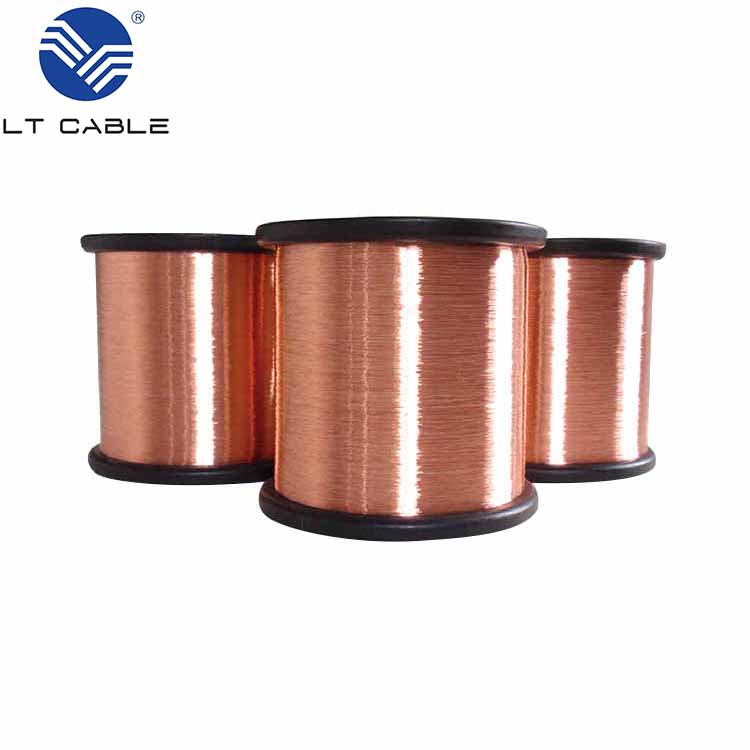
Electrical Performance: Why TCCAM Delivers Superior Conductivity and Lower Voltage Drop
IACS Benchmark Comparison: TCCAM at ~100% vs Tinned CCA at ~40–45%
Conductivity forms the foundation of any wire’s performance—and the International Annealed Copper Standard (IACS) provides a clear, widely accepted benchmark. Tinned Copper Clad Aluminum Magnesium (TCCAM) achieves an IACS rating near 100% because its core is pure copper, a material renowned for minimal electrical resistance. In contrast, tinned Copper Clad Aluminum (CCA) typically reaches only 40–45% IACS due to its aluminum core, which inherently resists electron flow more than copper. For system designers, this means a TCCAM conductor can carry the same current as a tinned CCA wire with a significantly smaller cross-sectional area—reducing weight and saving space in dense vehicle harnesses. The ~100% conductivity ensures power delivery remains efficient and uncompromised, directly translating to less energy lost as heat—a critical advantage in high-density automotive circuits where thermal management is tightly constrained. This isn’t a marginal difference; it’s a fundamental distinction rooted in material science that directly impacts reliability for sensitive components like sensors, actuators, and control modules.
Voltage Drop in Real Automotive Scenarios: 12V/30A Over 10ft Runs
A theoretical conductivity percentage becomes tangible when measured as voltage drop in real-world operation. Consider a common 12V automotive circuit powering a high-draw accessory—such as a cooling fan or auxiliary light bar—at 30 amps over a 10-foot run. Comparing 12 AWG TCCAM against 12 AWG tinned CCA reveals the practical consequences:
| Wire Type | IACS Conductivity | Estimated Resistance (10ft) | Calculated Voltage Drop | Power Lost as Heat |
|---|---|---|---|---|
| 12 AWG TCCAM | ~100% | ~0.016 Ω | 0.48 V | 14.4 W |
| 12 AWG Tinned CCA | ~45% | ~0.036 Ω | 1.07 V | 32.1 W |
The tinned CCA wire incurs more than double the voltage drop—delivering just 10.93 V to the load versus 11.52 V from TCCAM. That shortfall can trigger slower fan speeds, dimmer lighting, and erratic sensor behavior, since many electronic modules require stable voltage above 11 V for reliable operation. Worse, the excess energy converts into over twice the heat within the CCA wire—raising risks to insulation integrity and adjacent components. This example underscores that lower-conductivity conductors don’t merely waste power—they actively erode system reliability and performance.
Corrosion Resistance and Galvanic Stability in Harsh Automotive Environments
TCCAM’s Dual-Layer Protection: Tin Coating + Pure Copper Core Prevents Oxidation
TCCAM employs a dual-layer defense uniquely suited to harsh automotive conditions. Its tin coating forms a continuous, impermeable barrier against moisture, road salts, and underhood chemicals. Unlike plated steel, tin resists hydrogen embrittlement and retains protective integrity even after minor abrasion—critical at connector crimps and scuffed areas. Beneath the tin lies a pure copper core that remains chemically stable when exposed. If the tin layer is scratched, copper forms a thin, adherent oxide that limits further corrosion—unlike aluminum, which pits and exfoliates. This synergy preserves consistent terminal contact and prevents creeping oxidation that increases resistance and causes intermittent faults. Because TCCAM is homogenous copper throughout, it eliminates internal galvanic couples entirely—ensuring long-term durability under condensing humidity and salt-spray exposure.
Galvanic Risk in Tinned CCA: Aluminum-Copper Interface Degradation Under Heat and Humidity
Tinned CCA introduces an inherent galvanic vulnerability. Its structure—a thin copper cladding over an aluminum core, topped with tin—creates a built-in corrosion cell wherever the interface is exposed: at cut ends, crimp points, or nicks in the coating. Aluminum is anodic to copper in the galvanic series, so in the presence of moisture (especially salt-laden condensation), electrochemical corrosion accelerates. Cyclic heating and cooling draw electrolytes into micro-crevices, driving preferential aluminum corrosion and non-conductive oxide buildup. This forces current through narrowing paths, raising resistance and localized heat. Over time, interfacial stress leads to clad separation—a known failure mode where the copper skin detaches from the aluminum core, creating microcracks and eventual open circuits. Even intact tin coatings wear at crimp zones, re-exposing the galvanic couple. TCCAM avoids this entirely: no dissimilar-metal interface exists beneath the tin, so breach exposure poses no galvanic risk—only stable, predictable copper oxidation.
Long-Term Reliability: Thermal Cycling, Flex Fatigue, and Mechanical Integrity
Automotive wiring must endure thousands of heat-up and cool-down cycles without degrading electrical performance. A conductor’s response to thermal stress and repeated flexing determines whether connections remain stable—or drift toward failure.
How TCCAM Maintains Consistent Cross-Sectional Integrity Under Repeated Thermal Stress
TCCAM relies on a homogeneous copper core whose uniform thermal expansion coefficient eliminates interfacial shear stresses during cycling. Without dissimilar metal layers, there’s no bond line prone to delamination under thermal strain. Copper’s natural ductility allows it to absorb cyclic mechanical stress without microcracking, preserving original cross-sectional area over time. The tin coating adds corrosion resistance but introduces no mechanically distinct interface that could separate during flex or thermal cycling. As a result, resistance remains stable, and current-carrying capacity holds steady—even after prolonged exposure to engine-compartment heat and vibration. This intrinsic material consistency is why TCCAM sustains dependable electrical performance across the full service life of the vehicle.
CCA Failure Modes: Clad Separation, Microcracking, and Resistance Drift Over Time
Tinned CCA combines aluminum (CTE ≈ 23 µm/m·°C) and copper (CTE ≈ 17 µm/m·°C), creating a sharp mismatch in thermal expansion. Each temperature cycle generates shear stress at the clad interface, nucleating microscopic cracks that propagate over time. Progressive clad separation reduces the effective conductive cross-section—even partial delamination raises local current density, accelerating degradation. Simultaneously, exposed aluminum-copper interfaces become vulnerable to galvanic corrosion in humid environments, further eroding conductivity. The result is measurable resistance drift: independent testing shows tinned CCA can lose 10–15% of its rated current-carrying capacity after several hundred thermal cycles. In practice, this manifests as dimming lights, sensor errors, or intermittent failures—symptoms not of component malfunction, but of underlying conductor degradation.
FAQs on TCCAM vs. Tinned CCA
What does TCCAM stand for?
TCCAM stands for Tinned Copper Clad Aluminum Magnesium, a conductor that combines a pure copper core with a tin coating for superior electrical and mechanical performance.
How does TCCAM achieve ~100% IACS conductivity?
TCCAM leverages a pure copper core, which is highly efficient in conducting electricity, enabling it to match the conductivity of solid copper.
Why is voltage drop lower in TCCAM compared to tinned CCA?
Thanks to its near 100% conductivity, TCCAM has lower resistance, which significantly minimizes voltage drop during electrical transmission.
What makes TCCAM more corrosion-resistant in automotive environments?
TCCAM utilizes a dual-layer protection system with a tin coating and a copper core, which prevents oxidation and resists corrosion even under harsh conditions.
How does thermal cycling affect TCCAM and tinned CCA differently?
TCCAM’s single-material copper core avoids interfacial stress and remains stable under thermal cycling, whereas tinned CCA’s dissimilar materials can cause clad separation and resistance drift over time.


